

System Dynamics | Foundation 16: Self-Organization
Assembly Not Required

On where we are. Resilience, self-organization, and hierarchy are three structural properties that explain why complex systems work as well as they do, and why they’re so hard to see until they’re gone. This is the second of the three.
The largest reference work in human history was built by people who do not know each other, do not get paid, and do not agree on most things. Wikipedia has fifty million articles in three hundred languages. The four rules that govern it would surprise everybody with their shortness: anyone can edit, write from a neutral point of view, cite verifiable sources, work toward consensus. From those four rules, across two and a half decades, the largest collaborative knowledge structure ever assembled has emerged. “Emerged” is the right word, because no one assembled it.
I used to think complexity comes only from complexity, and can only go to more intense. I also used to think anything we cannot label as “simple” must be curated by somebody, somebody in charge and monitoring the system. Most people carry some version of these assumptions, and Wikipedia is one of the cleanest places to see them break.
The projects that tried to compete by tightening the rules failed. Citizendium required real names and credentials, Knol gave each article to a single named author, Britannica’s late attempts at openness were too gated to attract contributors. Each of these projects assumed that better assembly would produce a better encyclopedia. The structural question this raises is the question this article exists to answer: if no one is in charge, why is there structure at all?
The property
The capacity Wikipedia displays is called self-organization.
Self-organization is the capacity of a system to generate its own structure, to grow new form, to become more complex over time without external assembly.
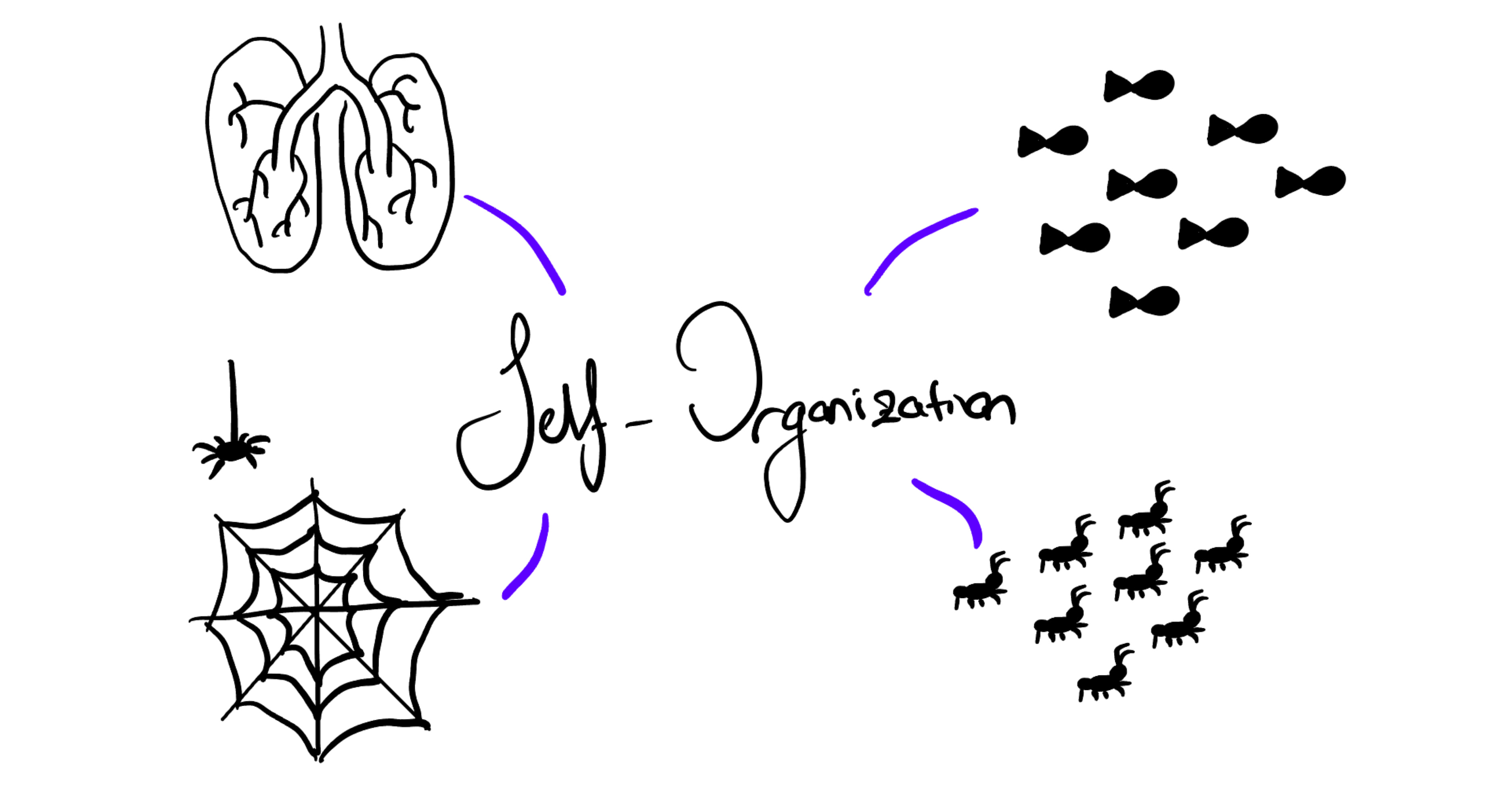
Donella Meadows treats it as one of the most marvelous and most underestimated properties of complex systems, and the range of phenomena it covers is deliberately wide: a snowflake forming on a window, a seed sprouting, a baby learning to speak, people organizing to protest. The same property, recognizable at radically different scales and in radically different substrates.
Three structural truths sit underneath it, and they are worth naming carefully because each one cuts against an assumption most readers carry without knowing they carry it.
Emergence. A self-organizing system produces properties that belong to the whole and to none of its parts, which is why classical analysis has so much trouble with these systems: there is nowhere in particular to look for the property you are trying to study. You can interview every Wikipedia editor in turn and never locate the encyclopedia in any of them, because the encyclopedia is not in the editors. It is in what the editors generate together over time.
Complexity of staggering depth can be generated by rules of striking simplicity. The four pillars produce fifty million articles. A handful of recursive operations on a triangle produce the Koch snowflake, whose edge has tremendous length and yet sits inside a finite circle. A relatively short string of chemistry, encoded in DNA, produces every form of life that has ever existed.
Trade-off. Self-organization, by its nature, produces heterogeneity, unpredictability, and outcomes that no central authority chose. These are precisely the properties that power structures, by their nature, find inconvenient. So self-organization gets suppressed, often deliberately, often in the name of productivity or stability or order, and the suppression looks reasonable in the short run because the costs do not arrive immediately. The costs arrive when the system, deprived of the variation it needs to generate its own next form, can no longer respond to anything it was not already prepared for.
Resilience, the property F15 examined, is what keeps a system from breaking under shocks the system has, in some form, already encountered. Self-organization is what built the system in the first place, and what keeps building it into something capable of meeting shocks no one has yet imagined.
The same property across substrates
Start with an equilateral triangle. Add a smaller equilateral triangle to the middle of each of its three sides, and on each of the new figure’s sides, add another triangle one-third smaller, and continue the operation indefinitely. The shape that emerges is the Koch snowflake, and one of its more disconcerting properties is that the length of its edge grows without bound while the figure itself remains contained within a finite circle.
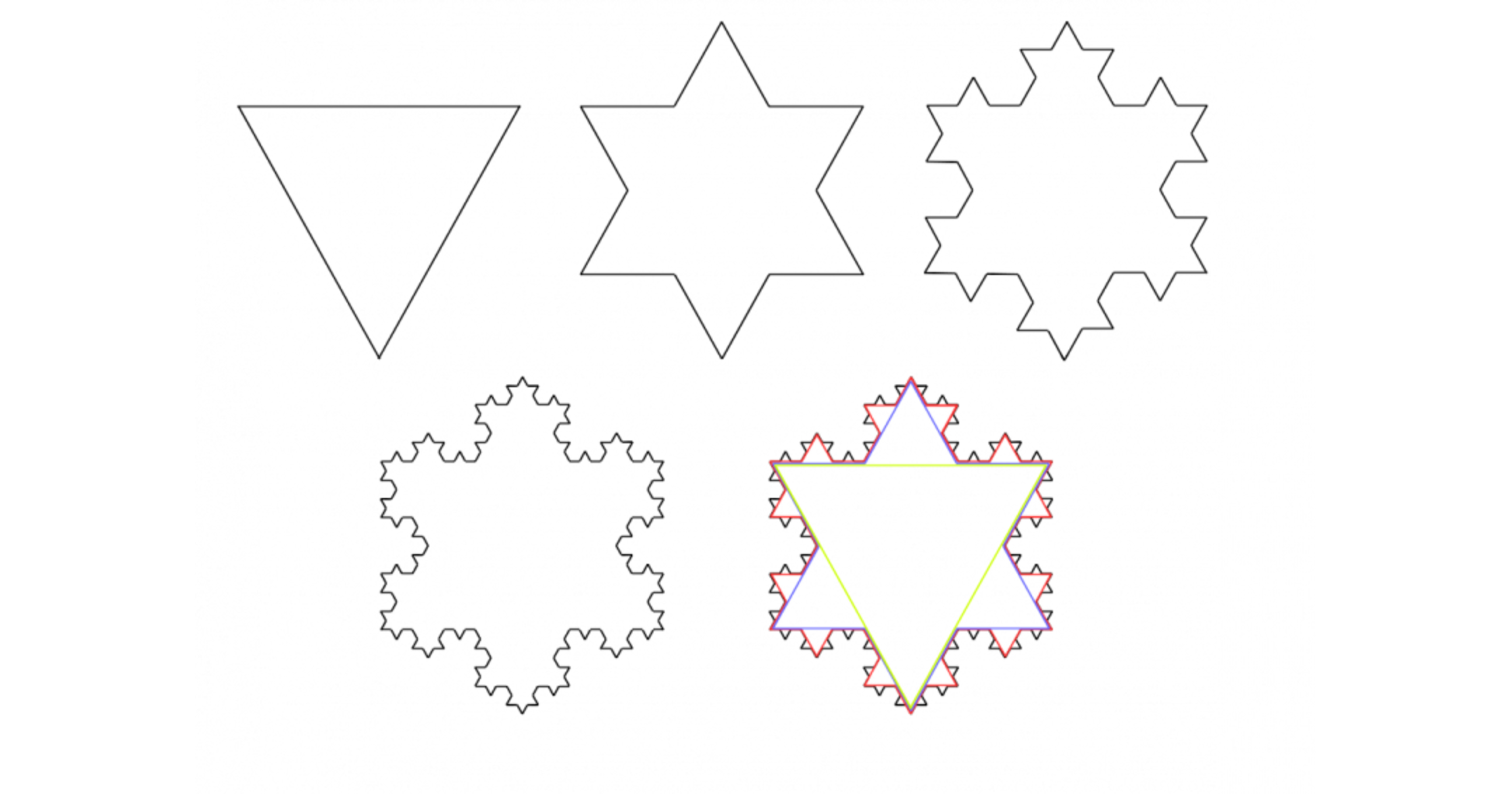
A rule of three sentences generates a perimeter that no measurement can ever finish. This is the geometric heart of fractal generation, and it is the same logic, simple rules iterated under conditions that allow variation, that produces the structure of the lung. The branching rule the lung follows is itself simple: each tube divides into smaller tubes, and the operation iterates across enough generations to produce, inside an organ that fits comfortably in the chest, a gas exchange surface large enough to cover a tennis court. The surface is not located in any single bronchiole, because the surface is not in the branches. It is in the recursion that produced them. Climate systems, coastlines, ecosystems all generate similar structure for similar reasons, and the family of phenomena chaos theory and complexity science began to map in the 1970s shares this signature: simple rules, iterated, producing complexity that no equation can fully resolve.
Language
The same property organizes systems made of nothing physical at all. You are reading this in a language no one designed and no one is in charge of, in which new words enter every year and old words quietly shift their meaning, and none of this is approved by any committee, because the committees that have tried to be in charge have lost. The Académie française was founded in 1635 specifically to regulate the French language, and it has spent four centuries losing to ordinary French speakers, who keep adopting English loanwords the Académie keeps officially banning. The language the Académie was created to protect has continued to evolve and complexify in spite of it. Every reader of this article is inside this example as you read.
Beyoğlu
The same property organized Beyoğlu into the cultural center of Istanbul, and the same property’s suppression hollowed it out. For most of the twentieth century, İstiklal Caddesi and the streets feeding into it formed a cosmopolitan substrate that no one had assembled and no authority was administering as a cultural center. Greek and Armenian families lived above the shops where Turkish, Kurdish, and Jewish neighbors worked alongside them, and rents were low enough that students and artists and journalists could live there without commercial logic dictating every move. The bookshop next to the meyhane next to the Greek pharmacy next to the Armenian tailor formed a daily mixture no planner had ever specified, and the cultural output of the neighborhood, the literature and the music and the political life that came to define it, was generated by the mixture rather than by any policy that named the area as cultural.
The suppression worked by removing the substrate, piece by piece, across decades. The 1955 pogrom emptied the neighborhood of much of its Greek and Armenian population in a single night, and the demographic transformation that followed proceeded through a long sequence of policy choices that made it harder for the remaining minorities to stay. Gentrification removed the cheap rents that had allowed the artists and the students to live there. The 2013 Gezi crackdown closed off the public commons the neighborhood had relied on as the stage for its political and cultural life. Tourism replaced the residents who had not already been displaced. The buildings remain, the theatre buildings remain, and you can walk past them on İstiklal any evening of the week. The Beyoğlu municipality still calls the area the cultural center of the city. But the conditions self-organization needed are gone, and what replaced the emergence is the assembled version: festivals curated from above, branded cultural districts, venues programmed for tourists who will not stay long enough to notice what is missing. Kadıköy is currently in the self-organizing phase, and what becomes of it depends on whether the conditions the emergence depends on are protected or dismantled by the same logic that hollowed out İstiklal.
You keep asking who decided these places would become centers of art and literature, and the answer is that nobody decided. The conditions decided. And once the conditions were dismantled, in many cases by the same authorities who later wished to brand the area as cultural, the emergence stopped, regardless of how many theatre buildings remained standing.
What is at stake
Self-organization, as Meadows observed, produces heterogeneity and unpredictability, and these are properties that power structures find inconvenient by their nature rather than by accident.
The structures suppress them, and the suppression is almost always justified in language that sounds reasonable: education must be standardized so that outcomes can be measured, economic policy must protect existing enterprises so that employment remains stable, governments must keep their populations within manageable bounds so that order is preserved. Each of these suppressions buys something real in the short run and trades away something that does not become visible until later, when the system is asked to respond to a situation it was not already prepared for and discovers that it can no longer generate the structure such a response would require. The Académie did not destroy French. The school system does not destroy a child’s curiosity in any single afternoon. The 1955 pogrom and the decades of policy that followed did not destroy Beyoğlu’s buildings. What each of these suppressions removed, for as long as the suppression lasted, was the variation the system needed in order to generate its own next form. The cost of that removal is not visible until the suppression ends or the system breaks, and by then the cost is everything the system did not become.
There is a smaller version of this same logic that lives in the texture of an ordinary life. The assumption that someone must be in charge for structure to exist is one of the more expensive assumptions a person can carry, and it tends to operate quietly enough that the costs are easy to miss. It costs you the conversations you do not start because no one has authorized them, the work you do not begin because no one has commissioned it, the small structures of community and friendship and creative life that you keep waiting for someone else to organize on your behalf. Self-organization is not chaos, and it is not magic. It is what happens when simple rules at the bottom encounter freedom and a small amount of disorder, and the system iterates long enough to surprise everyone, including itself. Once you can see the property at work in the snowflake and the lung, in Wikipedia and in language, in a neighborhood that built its own cultural life out of the conditions of ordinary daily mixing, the absence of an authority stops looking like a problem to be fixed.
The structure was never going to come from above. It was always going to come from the conditions, and the conditions are something that can be protected, or destroyed, or built.
🧩 What’s Coming Next
This foundations series will build your systems thinking toolkit step by step:
2 | Stop! Let’s Talk Stocks: Not Wall Street, Just Bathtubs ✔️
3 | Go With the Flow: Pipes, Currents, and Traffic Jams (A Love Story) ✔️
4 | Causal Loop Diagrams 101: Stop Talking, Start Drawing ✔️
7 | Reinforcing Feedback Loops: Congratulations, You Made It Worse ✔️
10 | One-Stock System Dynamics: Choose Your Own Catastrophe ✔️
14 | Exponential Growth & Collapse: Fine, Fine, Fine, Oh No ✔️
16 | Self-Organization: Assembly Not Required ✔️
17 | Hierarchy: Layers All the Way Down
📚 Main Resources
Meadows, D. H. (2015). Thinking in Systems. Chelsea Green Publishing.
Sterman, J.D. (2000) Business Dynamics: Systems Thinking and Modeling for a Complex World. Irwin McGraw-Hill, Boston.
My lecture notes from “System Dynamics” and “Simulation” classes :)
Some explanations and phrasings closely follow or directly quote these sources. The text was refined for coherence and citation accuracy with the assistance of large language models.
It captures so well how systems emerge through self-organization rather than control. The examples are spot on and never feel overwhelming, they just flow. Also I love the spider drawing (: