

System Dynamics | Foundation 14: Exponential Growth & Collapse
Fine, Fine, Fine, Oh No

I suppose you know the riddle about the lily pad that covers the pond. The story begins with a lily pad that covers one square foot of a pond, and every day the patch doubles. On day thirty, the pond is full. The question is: when was the pond half covered? The answer is day twenty-nine.
This seems odd to our linear thinking mind. The direct intuitive answer was fifteen, I know. It’s because our minds are used to linear equations, not nonlinear ones. But for today’s article, the part of this that matters is not day thirty. It is days one through twenty-eight, when the pond looked empty. A biologist taking a photograph on day twenty-six would have seen a pond. A reasonable person standing at the edge would have called it clean.
Bacteria in a flask behave the same way. A single cell divides on a schedule, and for most of the run, the flask is clear. The doubling is happening in every frame of the film, but the quantity is small enough that nobody sees anything. Then over the course of one or two divisions, the flask clouds. The interesting part of the experiment is not the clouding. It is the long stretch during which the system was already doing what it would finish doing, and no one could see it.
Let’s remember. On February 26, 2020, the United States had reported about sixty confirmed cases of a new respiratory virus, soon after we’d called it COVID-19. The people watching the numbers were looking at a pond on day twenty-six.
What gets called exponential growth is, structurally, a particular kind of blindness. The system is doing what its structure tells it to do, on a clock determined by that structure. Thus, the blindness comes from the observer, not from the system.
The naive reading reaches for an event. A superspreader, a mutation, a flight from somewhere. For the lily pad, a sudden warm spell. For the post, the algorithm. The mind that thinks this way is looking for the moment something tipped, because it assumes the system was stable until that moment and unstable after it. The assumption is wrong. There was no tipping. The structure had been running the entire time, doing exactly what its arithmetic told it to do. What changed was not the system. What changed was the point on the curve at which the numbers became large enough for a human being to notice them.
One Stock, One Loop, One Constraint
The structure here is the smallest one in the series so far. A stock whose inflow depends on its own size. More produces more. The larger the stock gets, the faster it grows, and the faster it grows, the larger it gets. One stock, one flow, one arrow from the stock back to the flow. This is a reinforcing loop in its purest form.
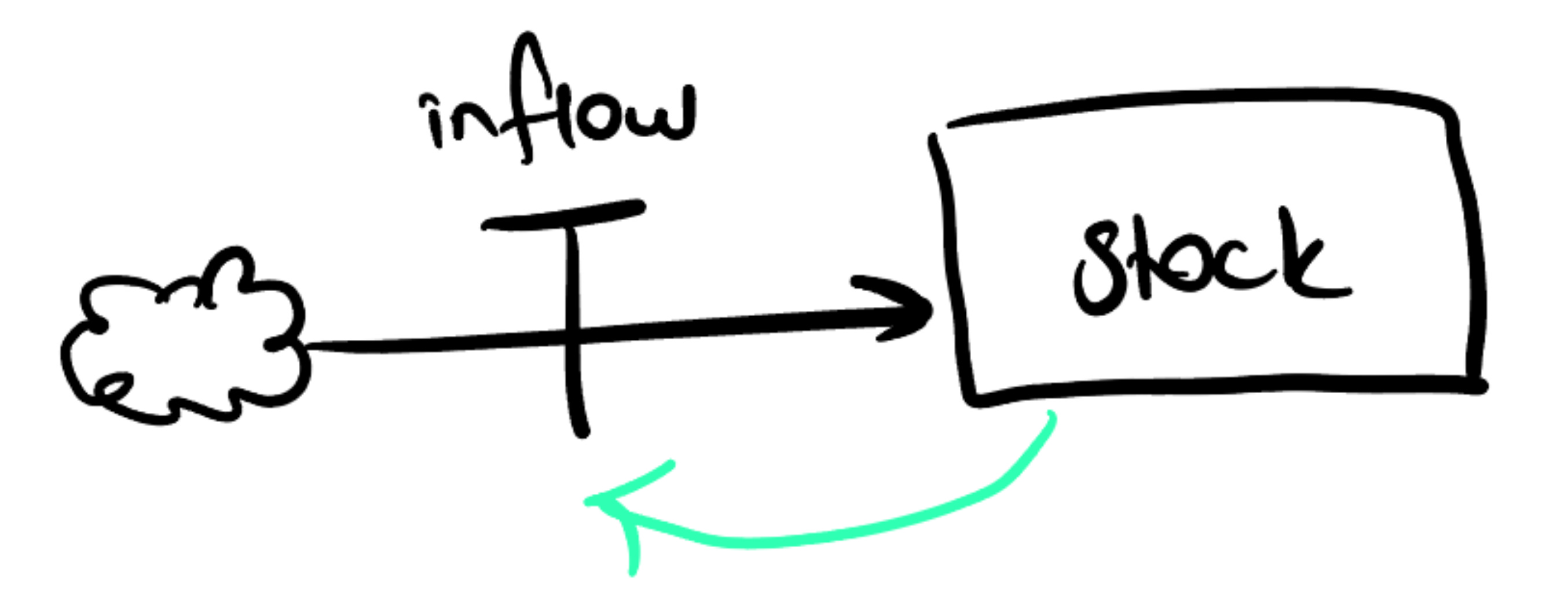
The shape is the same wherever it appears, and it appears in places that have nothing to do with biology. A social media post sits at two hundred views for three days. Each viewer shares it with some small probability. Most don’t, a few do. The people who see it from those shares also share it with some small probability. Nothing about the structure changes over those three days. The stock is simply still small. On the fourth day, the post has two hundred thousand views. The same reinforcing loop has been running the whole time. The clock was just faster than anyone was checking.
A virus in early 2020 had the same shape, only with people instead of views. The stock is infected people. The inflow is new infections. Each infected person transmits to some number of others over some period of time, and those people become part of the stock, and the stock determines the next inflow. Two boxes and one arrow. The same diagram as the lily pad. The same diagram as the post. The substrate changes, the structure does not.
What is missing from this structure matters as much as what is in it. There is no balancing loop. Nothing is correcting or balancing the stock, because nothing yet exists that could. Behavior change, immunity, intervention, institutional response… All the mechanisms that would eventually pull against the growth have not yet engaged. This is not a simplification of the model. It is a true feature of the system at this stage. A pandemic in its first month, a viral post in its first afternoon, a lily pad pond in its first three weeks. All of them share the same property, which is that the reinforcing loop is alone. The only thing producing behavior is the loop’s own arithmetic, and from inside our linear-thinking-dominated perspective, the early stretch of that arithmetic looks like nothing is happening.
A loop alone has no natural limit. It will not stop itself, because there is nothing in its structure that could stop it. Whatever eventually stops it has to come from outside the loop. For a hospital system, that outside thing is a finite number of beds, a finite number of ventilators, a finite number of trained staff who can run those ventilators. On the timescale of a month, that number is fixed. It is a ceiling, a line drawn across the graph, a quantity the reinforcing loop will eventually meet.
And the reinforcing loop does not know the ceiling exists. A reinforcing loop has no information about its environment. It has information only about itself. The stock grows, the flow grows with it, and the loop continues to produce the behavior it was always going to produce. The constraint is not a signal the loop can read. It is a wall the loop is walking toward at a speed determined entirely by its own internal arithmetic.
Doubling Time
A stock under the dominance of a reinforcing loop has one number that determines everything about its trajectory: doubling time. How long it takes the stock to become twice what it was. For the virus in early 2020, across multiple countries and multiple measurements, the figure was two to three days.
Take a city with two thousand ICU beds. Assume, for the sake of clean arithmetic, that the doubling time is two days and the stock of cases needing an ICU bed tracks the stock of infections. At two thousand cases, the city is at capacity. At one thousand, the city is two days from capacity. At five hundred, four days. At two hundred and fifty, eight days. At one hundred and twenty-five, ten days.
In February 2020, two hundred and fifty cases in a city of several million read as contained. It was the kind of number that produced a chart with a low line on it and a lot of white space above. The eight days between that number and the hospital wall were not a warning period. They were the entire remaining history of the system before the collision.
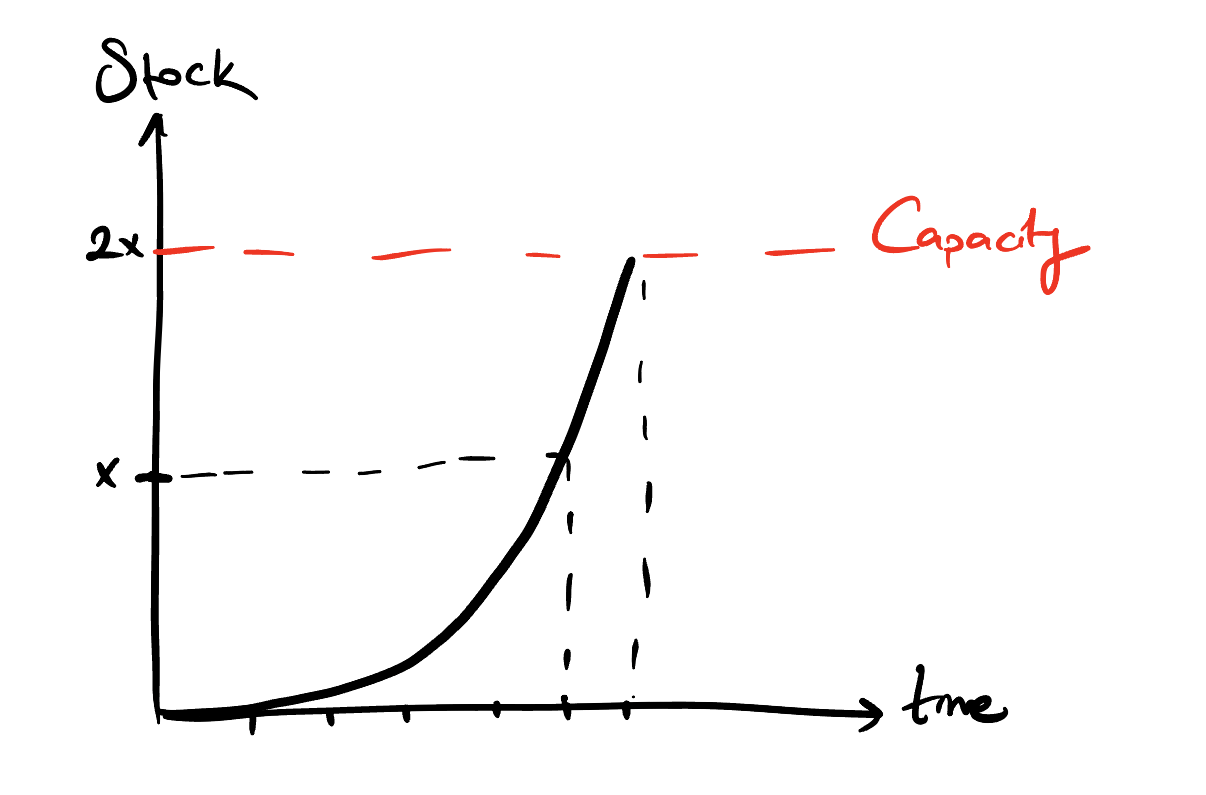
Now the definition, since you are already feeling it. A stock under reinforcing-loop dominance has a constant doubling time. It doubles in a fixed period regardless of how large it has become. Linear thinking estimates the next interval by the size of the last one. If the stock grew by a hundred yesterday, the linear estimate for today is about a hundred. Exponential growth breaks this estimate in a specific way. The next interval is not proportional to the last one. The next interval is the same size as everything that came before it combined. Day twenty-nine produces as much lily pad as the first twenty-eight days produced together. Day thirty produces as much as day twenty-nine. Meadows is also explicit that a reinforcing loop can run in the other direction: the same structure that produces doubling can produce halving, and a stock losing a fixed fraction of itself per period collapses on the same schedule that growth would expand it on. The arithmetic is symmetric. Yet, the blindness is not.
Back to the pond. On day twenty-nine, the pond is half covered. A person looking at it sees a pond that is mostly water. The structural fact is that the pond is one doubling from full. Half covered is not the midpoint of the process in any meaningful sense. It is the last moment before the end. A hospital system at half capacity, growing on a two-day doubling time, is in the same position as the pond on day twenty-nine. The moment that looks like plenty of room is the moment the system is structurally closest to the wall.
Foundation 13 was also a story about a system that ran past a limit, but the mechanism was different. In F13 there was a balancing loop, and it was firing. It was just firing on stale information, by the time the corrective action arrived, the resource it was trying to protect had already passed the point at which it could recover. The collapse was overshoot. The balancing loop was late. In F14 there is no balancing loop at all. Nothing is regulating the stock, nothing is reading the constraint, nothing is firing late because nothing is firing. The collapse, when it arrives, is not overshoot. Here, it is collision, a reinforcing loop meeting a wall it never had a mechanism to see.
What You Can Now See
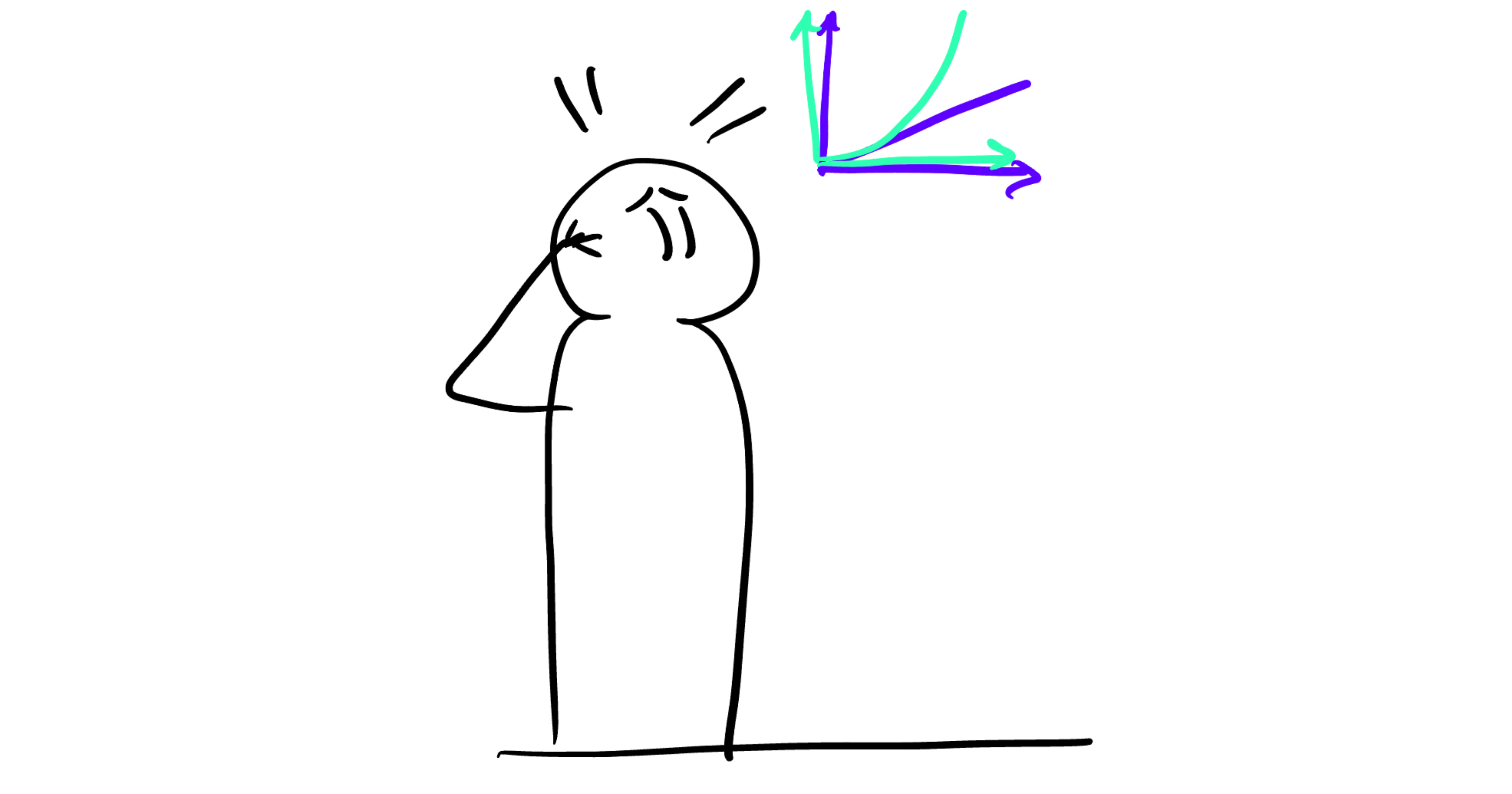
No human institution has a perception horizon shorter than two days. The fastest serious ones operate on a weekly cycle, and most operate on monthly or quarterly ones. When a reinforcing-loop-dominated system has a doubling time shorter than the perception horizon of the people watching it, the system is structurally invisible until it is structurally finished. By the time the number is large enough to cross the threshold of institutional attention, the remaining distance to the constraint is one or two doublings, and those doublings will complete on a clock the institution cannot match. This is not a failure of attention, or competence, or political will, or character. It is a property of the relationship between two timescales. One belongs to the system. The other belongs to the observer. When the first is shorter than the second, the observer is operating on structurally stale information no matter how carefully they look.
Which means that when you look at a system and see comfortable headroom, you are not seeing the state of the system. You are seeing one variable, the current level of the stock, without the second variable that determines whether the headroom is real. The second variable is doubling time. A pond that is half covered and doubles every day is one day from full. A pond that is half covered and doubles every year is a year from full. The visible quantity is identical in both cases. The state of the system is not. Headroom without doubling time is not information. It is the absence of information dressed as information.
The thing you were calling headroom was never headroom. It was the part of the curve that hadn’t gotten loud yet.
🧩 What’s Coming Next
This foundations series will build your systems thinking toolkit step by step:
2 | Stop! Let’s Talk Stocks: Not Wall Street, Just Bathtubs ✔️
3 | Go With the Flow: Pipes, Currents, and Traffic Jams (A Love Story) ✔️
4 | Causal Loop Diagrams 101: Stop Talking, Start Drawing ✔️
7 | Reinforcing Feedback Loops: Congratulations, You Made It Worse ✔️
10 | One-Stock System Dynamics: Choose Your Own Catastrophe ✔️
14 | Exponential Growth & Collapse: Fine, Fine, Fine, Oh No ✔️
15 | Resilience: The Group Project Member Who Actually Shows Up
📚 Main Resources
Meadows, D. H. (2015). Thinking in Systems. Chelsea Green Publishing.
Sterman, J.D. (2000) Business Dynamics: Systems Thinking and Modeling for a Complex World. Irwin McGraw-Hill, Boston.
My lecture notes from “System Dynamics” and “Simulation” classes :)
Some explanations and phrasings closely follow or directly quote these sources. The text was refined for coherence and citation accuracy with the assistance of large language models.
This series has been incredibly helpful and accessible for someone completely new to SD