

System Dynamics | Foundation 2: Stocks
Stop! Let’s Talk Stocks: Not Wall Street, Just Bathtubs. Where Systems Keep Their Stuff.

We’ve talked about system and its embedded characteristics. Now, it’s time to dive in the real world of system dynamics, learn about “stocks” and “flows”. Let’s start with the most heavy one: Stock.
Every system has a memory, an accumulation of everything that has happened to it over time. The water in your bathtub represents every drop that flowed in minus every drop that drained out. Your bank account reflects every deposit and withdrawal. Your relationship carries every conversation and conflict.
These accumulations, whether water, money, or trust, are what system thinkers call “stocks.” They’re the present memory of a system’s past, and they’re absolutely foundational to understanding how systems behave.
Stocks: What They Are
A stock is simply a store, a quantity, an accumulation of material or information that has built up over time. Stocks characterize the state of the system at any given moment.
Look around you right now. The books on your shelf is a stock. Your knowledge level is a stock. The money in your wallet, the food in your refrigerator, the contacts in your phone, all stocks. In a city, the population is a stock. In a forest, the number of trees is a stock. In the atmosphere, the concentration of carbon dioxide is a stock.
If you took a snapshot and froze time, stocks are what you could count or measure in that frozen moment. You could measure how much water is in a bathtub, but you couldn’t tell whether it’s rising or falling. You could count a company’s inventory, but you couldn’t determine the rate at which it’s changing. Stocks don’t change by themselves. They change through “flows”, the rates at which things move into or out of them.
Flows: What Changes Stocks
Flows control what will happen to system’s stocks in the next moment. They either increase stock as inflow or decrease as outflow. Birth and death change population stocks. Purchases and sales change inventory stocks. Income and expenses change your bank account stock. Learning and forgetting change your knowledge stock. Trust-building and betrayals change your credibility stock. In order to differentiate stocks and flows, we can go back to our snapshot test. In the snapshot, the things you can count or measure are stocks but you cannot capture flows. That’s because “stocks” exist in space while “flows” exist in time.
In technical language, stocks are also called integrals, levels or state variables, while flows are called rates or derivatives. But you don’t need mathematics to understand the concept, just watch any bathtub.
The Bathtub Thought Experiment
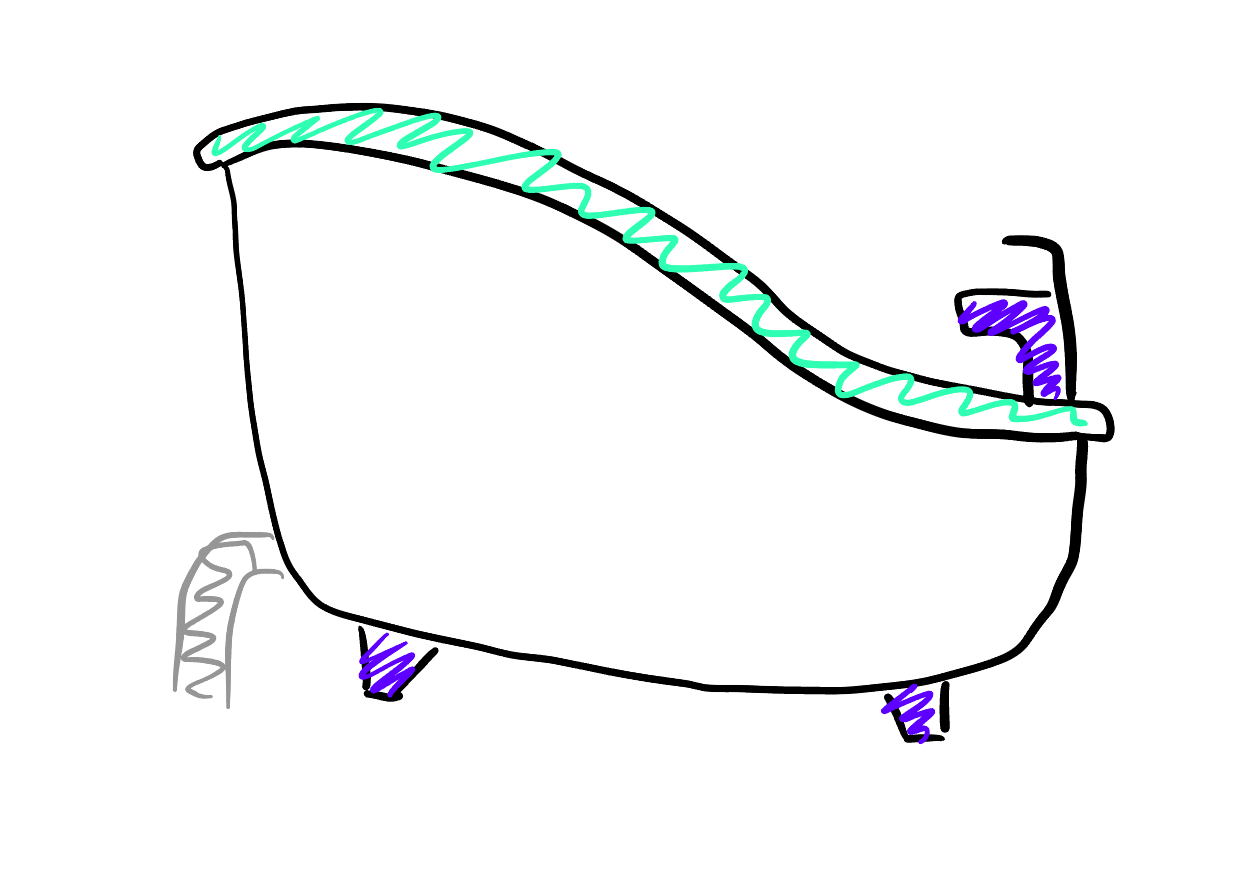
Imaginary Bathtub 1
Imagine a bathtub full of water. The drain is plugged, the faucets are off. Pull the imaginary plug. You can see that water drains out, in other words the stock decreases through an outflow.
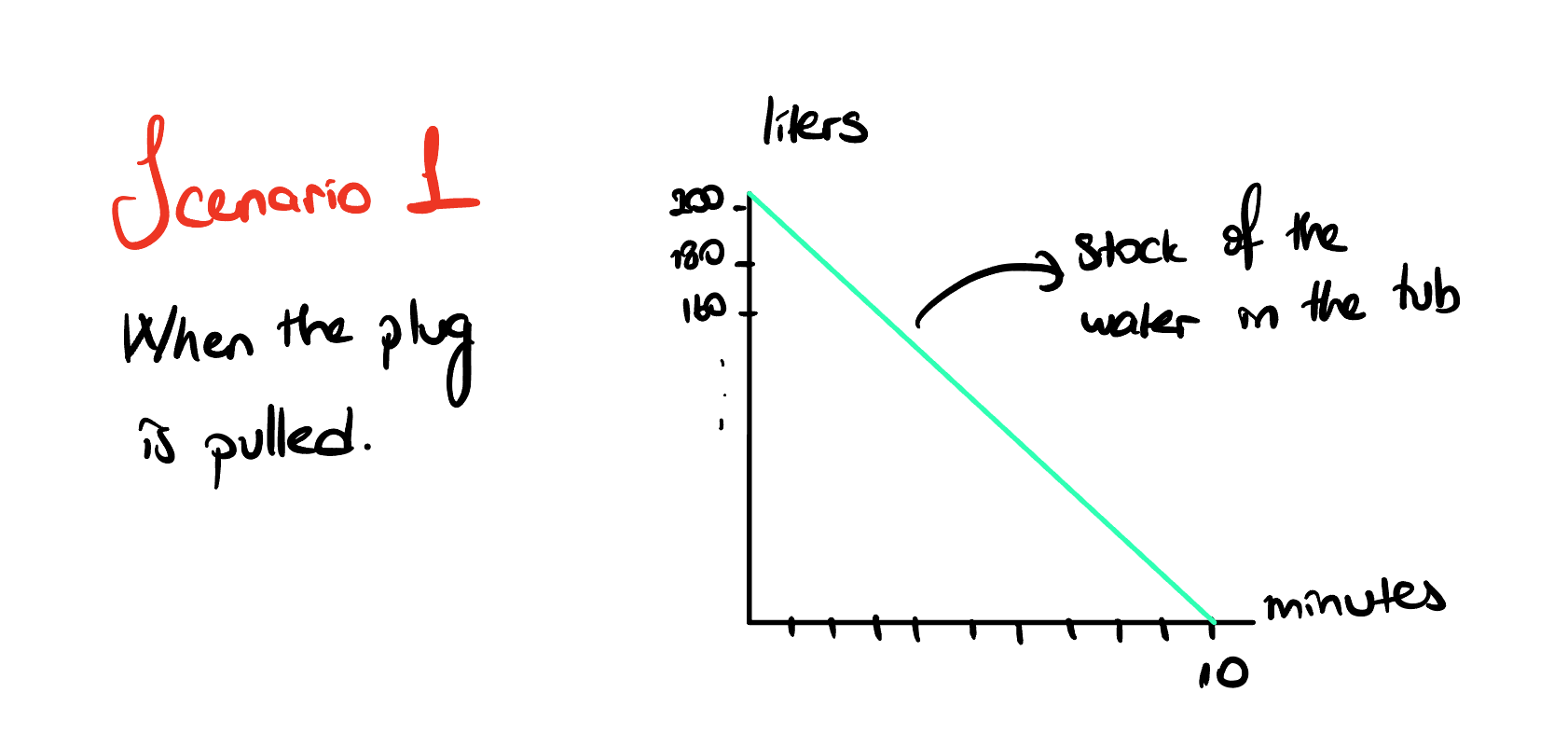
Imaginary Bathtub 2
Now start over with another full imaginary tub. Open the drain again, but this time, when the tub is half empty, turn on the imaginary faucet so water flows in at exactly the same rate it flows out. Try to see the dynamics. What happens?
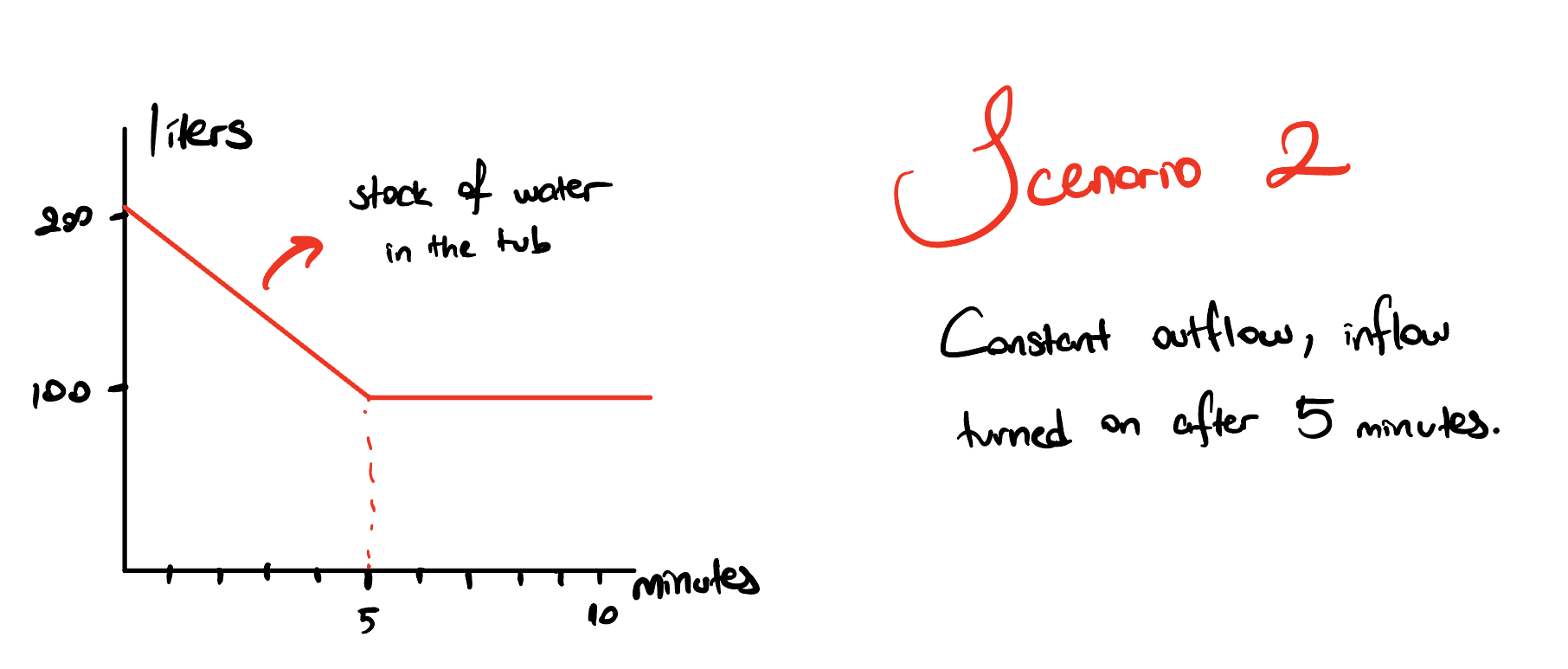
The water level stops changing when you balance the “in”s and the “out”s. It holds steady at whatever level it reached when inflow matched outflow. The stock has reached so called “dynamic equilibrium”, all inflows and outflows are summed up to zero. The state is not changing, even though water continuously flows through it.
Imaginary Bathtub 3
Now, imagine the last bathtub example that is in the dynamic equilibrium. It has constant and equal inflow and outflow. This time, turn the faucet up slightly (increased inflow) while keeping the drain constant (constant outflow). Can you see what happenes to your imaginary bathtub’s water level? Yes, the water level slowly rises. When you turn the faucet back down its original level to match the outflow exactly, -try to imagine. Yes, the rising stops.
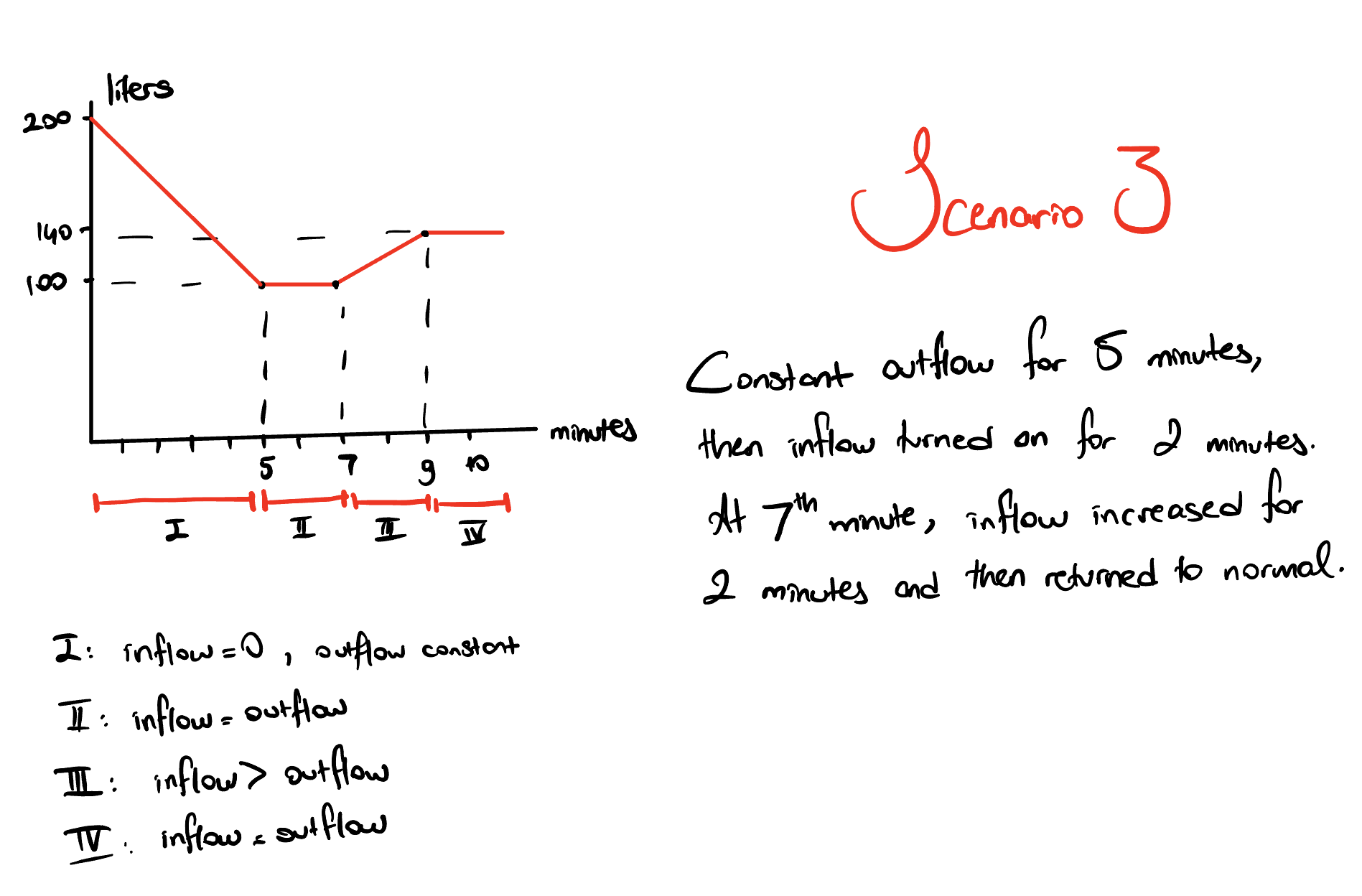
In this thought experiment, of course, I have assumed that evaporation from the tub and the time we adjust the faucet are insignificant, so I have not included that outflow. Like all models, whether mental or mathematical models, are simplifications of the real world. We, as modelers, decide what to include and what to exclude for the model due to the system’s function or purpose, mentioned in the earlier post.
This simple bathtub model -one stock, one inflow, one outflow- reveals principles that apply to every system, no matter how complex:
When total inflows exceed total outflows, the stock rises
When total outflows exceed total inflows, the stock falls
When inflows equal outflows, the stock holds steady in dynamic equilibrium
Why This Matters: The Momentum Problem
Go back to our imaginary bathtub setting. You can adjust a bathtub’s faucet or drain instantly, yes, but you cannot change the water level instantly. Water can’t run out immediately, even with the drain wide open. The tub can’t fill up instantly, even with the faucet on full blast. In other words:
“Stocks take time to change because flows take time to flow.”
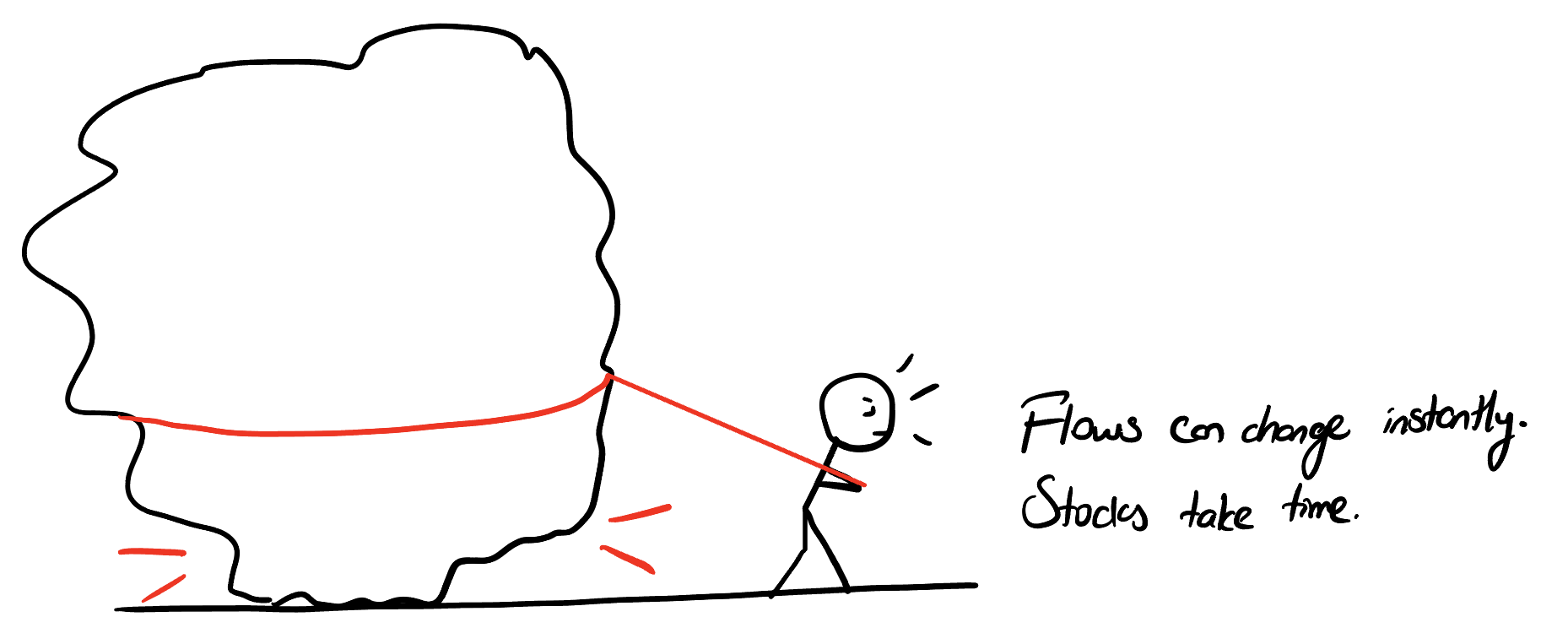
This is why systems behave the way they do. Stocks, especially large ones, respond to change -even dramatic, sudden change- only by gradual filling or emptying. They create momentum, inertia, delays. They act as buffers and ballast.
People consistently underestimate this inherent momentum. Cultural norms take generations to shift, the legal end of slavery didn’t instantly erase its practices from society. Even if we devoted every resource to cleaning the oceans today, ecosystem recovery would take decades. Forests don’t grow overnight. Skills learned over years aren’t forgotten in a day.
These time lags cause problems, industrialization can’t proceed faster than factories can be built, climate change can’t be reversed faster than atmospheric carbon can be absorbed. But slow-changing stocks also stabilize systems. Soil accumulated over centuries rarely erodes all at once. Strong relationships cannot be damaged by daily arguments. The time lags create room to maneuver, to experiment, to revise failing policies before damage becomes irreversible.
The Power of Decoupling
Stocks do something else remarkable: they allow inflows and outflows to be independent and temporarily out of balance.
You can’t harvest a forest at the precise rate trees grow, stocks of timber allow flexibility. Banks let you earn money at a different rate than you spend it, your account stock absorbs the difference. Inventory stocks along supply chains let production run smoothly even when customer demand higly varies.
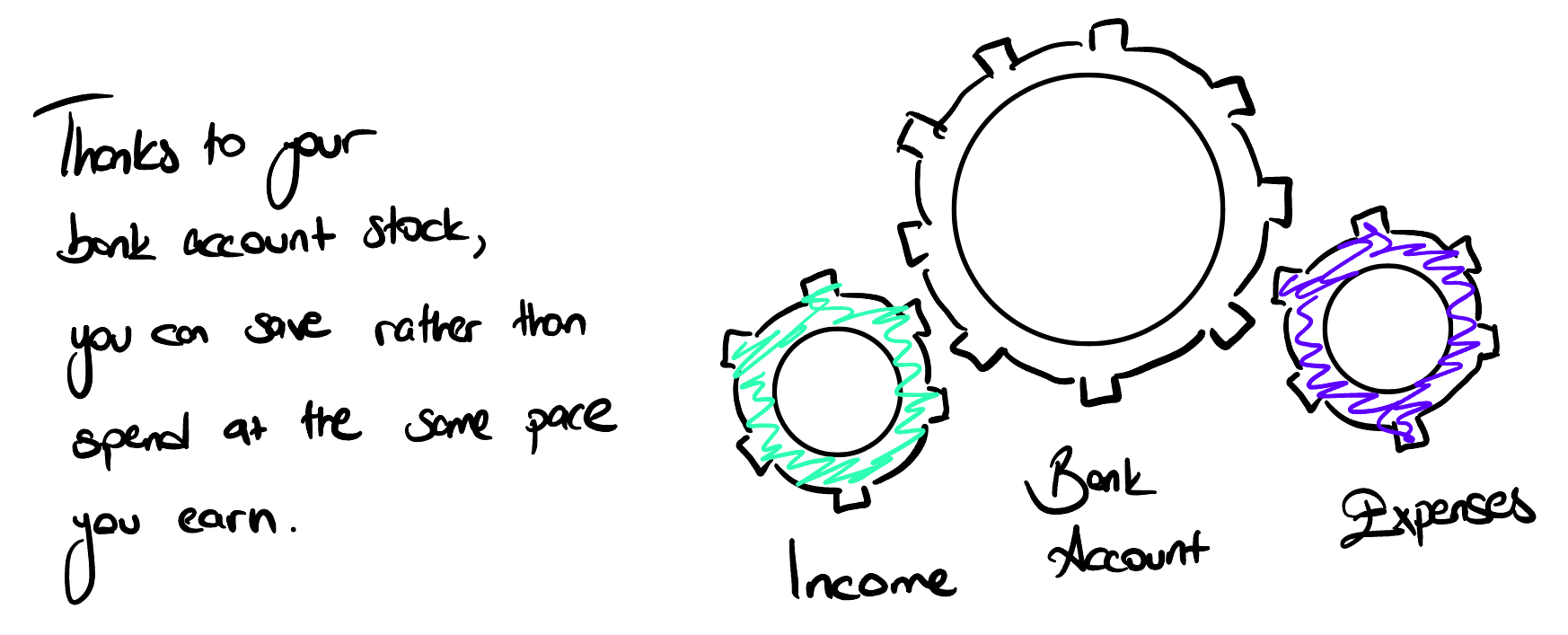
Without grain stocks, consumption would have to equal production at every moment. People would starve between harvests. Stocks create breathing room.
In Result
Stocks play four critical roles in every system:
1. They define the system’s state and inform action.
A pilot must know altitude, fuel level, position, and heading -all stocks- to fly safely. You check your bank balance before making purchases. Companies monitor inventory before adjusting production. We constantly track stocks and make decisions to raise, lower, or maintain them within acceptable ranges.
2. They provide inertia and memory.
Stocks accumulate past events and change only through inflows or outflows. The stock of ozone-destroying chlorine generated by past CFC emissions will persist in the atmosphere for decades even if production dropped to zero tomorrow, because its decay rate is extremely slow. Past actions echo forward through stocks.
3. They create delays.
All delays involve stocks. By definition, a delay is a process whose output lags behind its input. The delay between planting seeds and harvesting crops reflects the stock of growing plants. The delay between education policy changes and workforce skill levels reflects the stock of people moving through the system.
4. They enable disequilibrium dynamics.
Stocks absorb differences between inflows and outflows, allowing the rates to diverge. Inflows and outflows differ because different decision processes govern them, rainfall and evaporation, births and deaths, production and consumption all follow independent rhythms. Disequilibrium is the rule, not the exception. This is what makes systems dynamic rather than static.
Seeing the World Through Stocks
System thinkers see the world as a collection of stocks and the mechanisms that regulate them by manipulating flows. This perspective immediately reveals why so many interventions fail.
Failure to distinguish between stocks and flows leads to three common errors:
Underestimating time delays: Assuming that turning off the faucet means the tub empties instantly.
Short-term focus: Ignoring that today’s stock levels reflect decades of accumulated flows.
Policy resistance: Not recognizing that stocks have momentum that resists quick changes.
When politicians promise rapid transformation, they’re often ignoring stock dynamics. When companies expect instant culture change after a new mission statement, they’re forgetting that organizational culture is a stock accumulated over years. When individuals expect immediate results from new habits, they’re not accounting for the time it takes to build the stock of changed behavior.
A bathtub, after all, is just a bathtub. But the principle it illustrates governs everything from atmospheric carbon to cultural attitudes to your savings account.
Understanding stocks means understanding why change is often slower than we want but also more stable than we fear. It’s the foundation for thinking about how systems actually work, not how we wish they would work.

👋🏽 Before You Go
Next time you face a stubborn problem, whether in your organization, your community, or your life, ask yourself: What are the stocks? What are the flows? How long does it take for the flows to significantly change the stocks?
🧩 What’s Coming Next
This foundations series will build your systems thinking toolkit step by step:
2 | Stop! Let’s Talk Stocks: Not Wall Street, Just Bathtubs ✔️
3 | Go With the Flow: Pipes, Currents, and Traffic Jams (A Love Story)
📚 Main Resources
Meadows, D. H. (2015). Thinking in Systems. Chelsea Green Publishing.
Sterman, J.D. (2000) Business Dynamics: Systems Thinking and Modeling for a Complex World. Irwin McGraw-Hill, Boston.
My lecture notes from “System Dynamics” and “Simulation” classes :)
Some explanations and phrasings closely follow or directly quote these sources. The text was refined for coherence and citation accuracy with the assistance of large language models.
What if I hit the bathtub with a hammer and create a hole to empty it out faster🤔