

System Dynamics | Foundation 11: Delays
Everything Is Fine (As of Six Months Ago)

She said it came out of nowhere.
They had been together four years. He had been pulling away for six months; shorter answers, fewer questions, weekends spent in separate rooms. She noticed none of it. Not because she was careless. Because her perception of the relationship was built from years of accumulated evidence, and that model revised slowly. By the time her read matched his actual state, he was already done.
She did not miss the signals. She received them on delay.
You have done this with your own body. Day three of antibiotics, the fever breaks. You feel fine. You stop. Two weeks later the infection returns, because the bacterial population was still clearing when your perception of recovery arrived and overrode the treatment.
The 2008 financial crisis did not begin with the crash. Risk accumulated in mortgage-backed securities for years while dashboards reported lagged indicators of health. By the time the signal updated, the structure had already passed the point of correction.
Three situations. One structure. A cause happens. An effect will follow. But between them sits a gap in time, and inside that gap, every decision is being made with information that is already wrong.
What a Delay Actually Is
A delay is a structural property of a system in which a cause and its effect are separated in time. A characteristic of the feedback structure itself.
Two types, structurally distinct.
Material delay: A process through which physical entities transit over time. Orders enter a production pipeline and exit as finished goods after a residence time determined by the process. A drug enters the bloodstream and reaches therapeutic concentration after absorption and distribution. The stock in a material delay represents entities physically in transit: work-in-progress, goods in shipment, molecules in metabolism. The delay time is a physical property of the pipeline. The person experiencing a material delay generally knows they are waiting: the package has not arrived, the concrete has not cured. The delay is visible.
Information delay: A process through which a signal about the state of the world updates over time. No physical entity moves. Instead, a perceived value adjusts toward an actual value through a smoothing proces, the perceived quantity corrects itself at a rate proportional to the gap between actual and perceived, governed by the delay time. A company does not know today’s true demand; it knows a smoothed average of recent sales, lagging actual demand by a period determined by the averaging window. The stock in an information delay represents a belief (perceived demand, perceived quality, perceived effort) and the delay time governs how quickly that belief tracks reality. The critical asymmetry: a person experiencing an information delay typically does not know their perception is stale. They believe they are seeing the present. They are seeing the present as of some time ago.
Foundation 8 showed that a balancing feedback loop produces smooth goal-seeking: discrepancy → corrective action → stock adjusts → discrepancy closes. That assumed perfect, immediate information. Remove that assumption, put a delay inside the loop, and the same structure, same variables, same polarity, produces completely different behavior.
The Car Dealer
A car dealer maintains inventory on her lot. Sales draw it down; deliveries from the factory build it back up. She has a desired inventory level. When actual inventory falls below it, she perceives a discrepancy and orders more. One stock, one balancing loop. In other words, structurally, this is pure goal-seeking.
But the loop does not close instantly. It contains three delays, each sitting at a different point in the causal chain.
Perception delay (5 days). She does not react to a single day’s sales, that would be noise. She averages recent sales to estimate true demand. Her perceived demand therefore lags actual demand by five days.
Response delay (3 days). When she decides to adjust orders, she does so gradually, partial corrections spread over three days rather than one large order. The adjustment propagates slowly.
Delivery delay (5 days). Once ordered, cars take five days to arrive. The order is placed into a pipeline. What comes out the other end reflects decisions made five days earlier.
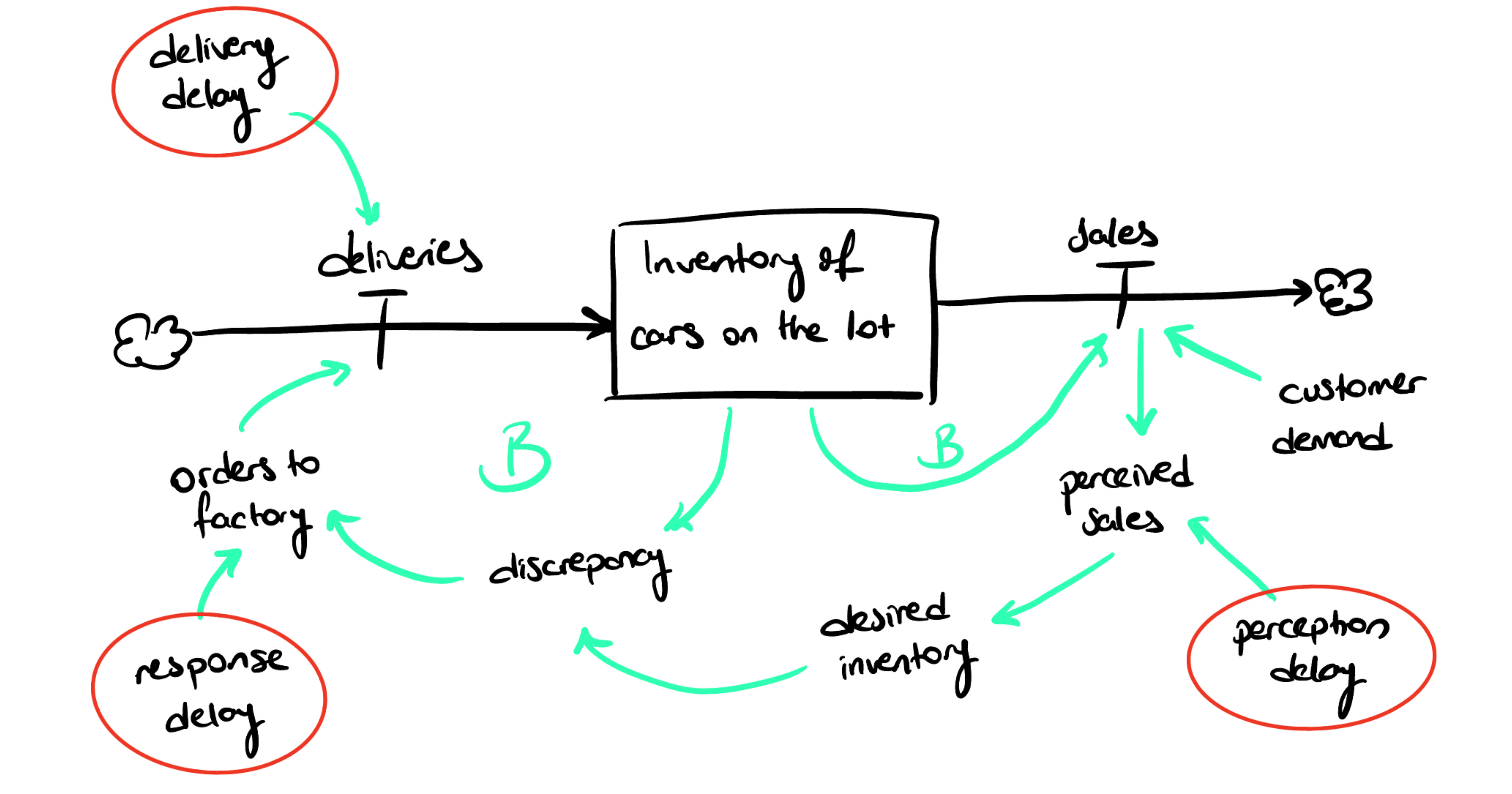
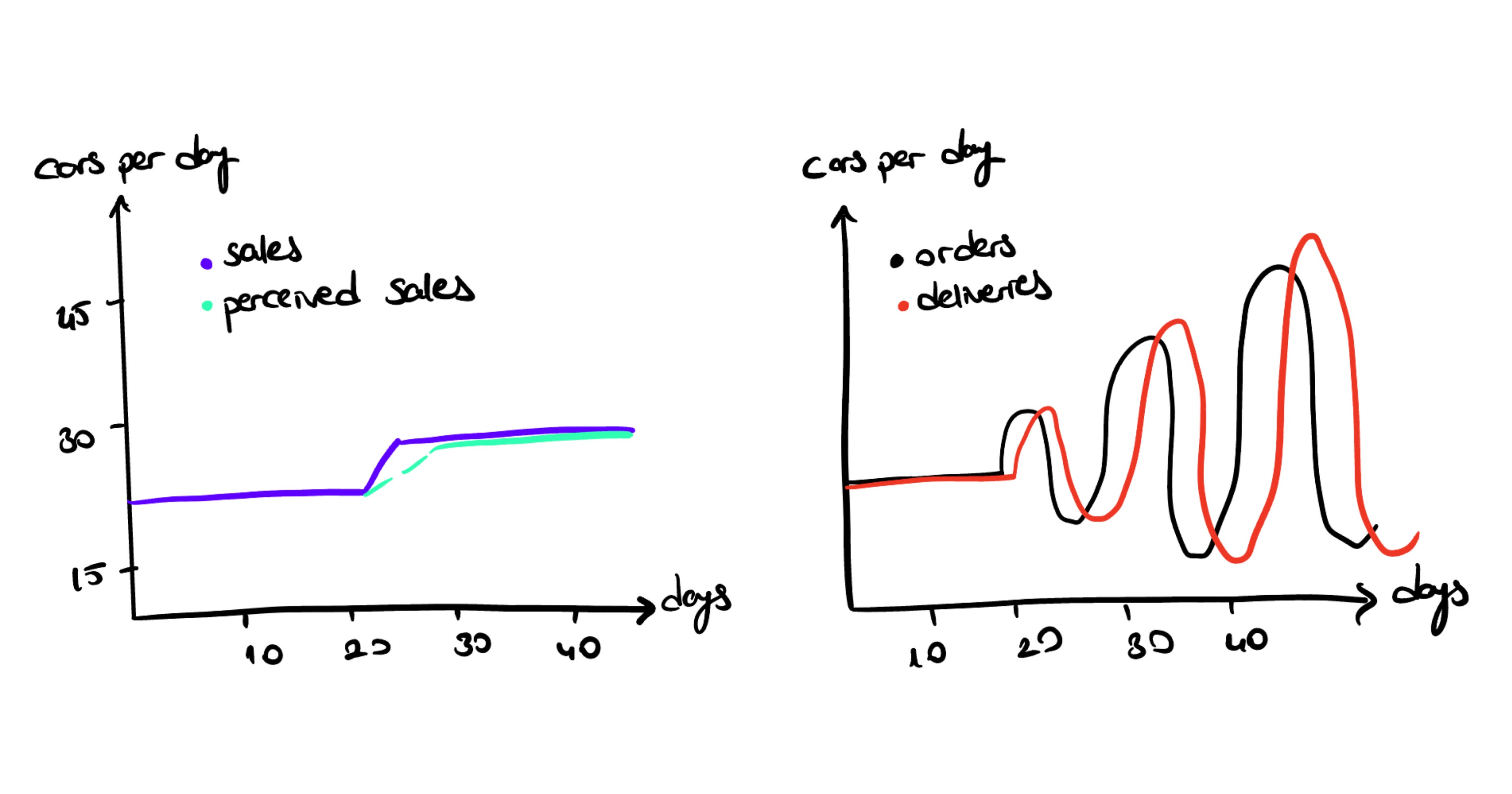
Now trace what happens when customer demand steps up ten percent -a small, permanent increase.
Sales rise immediately. Inventory begins falling. The dealer does not perceive this for five days. When she does, she begins adjusting orders upward, gradually, over three days. Those orders enter the delivery pipeline and arrive five days later. Thirteen days have passed since demand increased. During all thirteen, inventory kept falling. The discrepancy she is now reacting to has been accumulating the entire time.
She orders aggressively. Those orders arrive, but so do the earlier, smaller orders still working through the pipeline. Inventory overshoots. She sees a surplus and cuts orders. The cuts take time to propagate. Inventory drops again.
Same structure that produced smooth goal-seeking in Foundation 8. Same stock, same loop, same polarity. Add delays. Get oscillation.
The Counterintuitive Test
The dealer tries to fix it. Her instinct whispers: react faster.
She shortens her perception delay, averages over two days instead of five. Almost nothing changes.
She shortens her response delay, corrects immediately. The oscillation gets worse.
She shortens both. Things get very much worse.
Reacting faster to stale information does not produce faster convergence. It produces more aggressive overcorrection. She is making bigger moves based on data that is still delayed by the delivery pipeline, swinging the steering wheel harder while looking through the same lagged windshield.
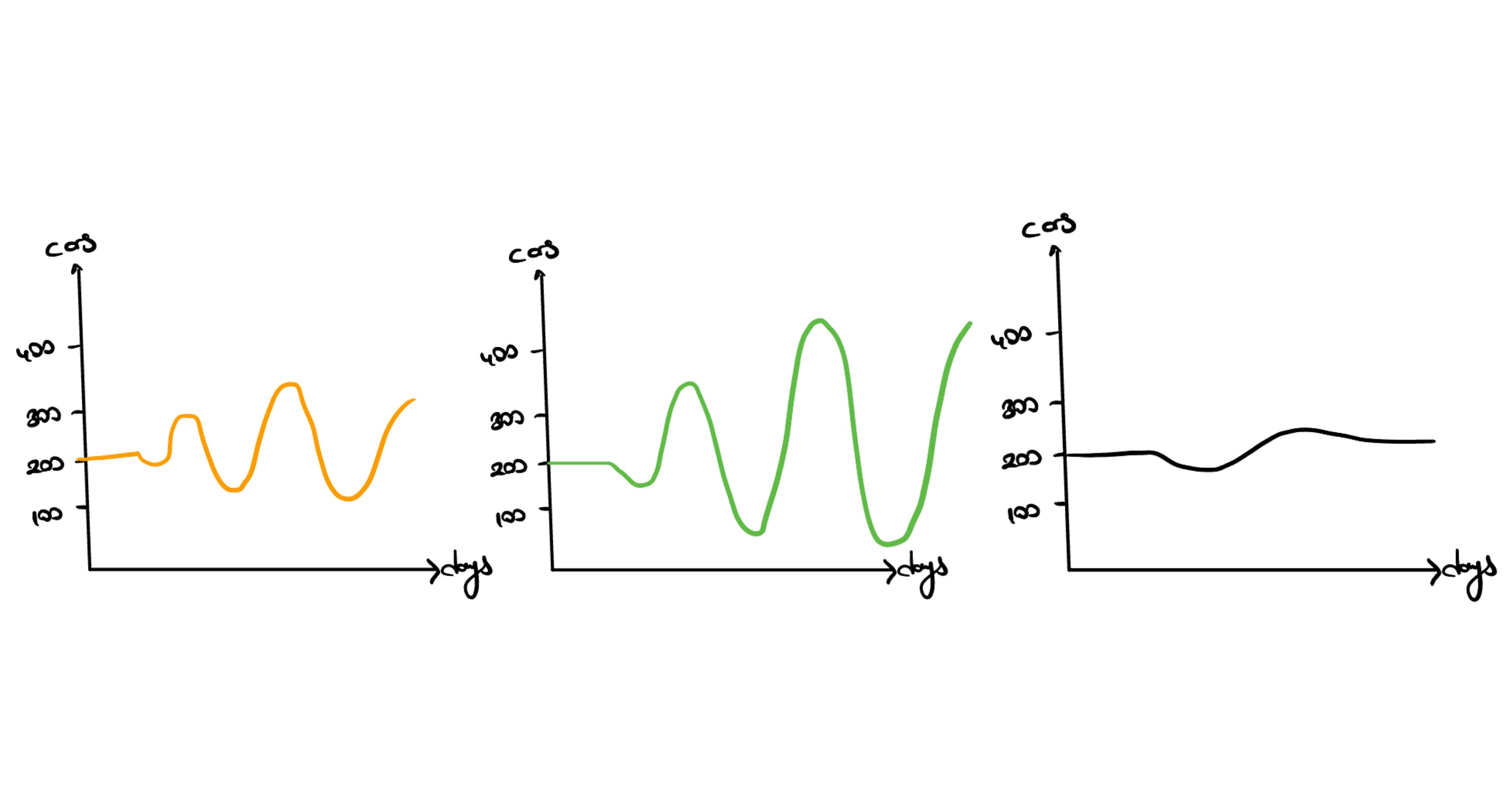
The delay with the most leverage is the delivery delay, the one she does not control. And the fix she can control? Lengthening her own response time. Reacting more slowly to information she knows is stale.
Meadows calls this “high leverage, wrong direction.” The intuitive fix as be faster, more responsive, more aggressive is structurally backwards.
The Relationship
Jane and Joe have been together for years. The relationship has drifted as communication thinned, responsiveness dropped. The stock -call it relationship quality- has been declining.
Joe wakes up to it first. Decides to change. Starts showing up differently: more present, more communicative. The change is real. It begins on a specific day.
Jane does not notice on that day. Jane’s perception of Joe is built from months of accumulated evidence, a mental model that revises through an information delay. One good week does not override eight months of drift. The smoothing is structural, not emotional but it means Jane cannot yet perceive the signal.
Two weeks of genuine effort. Nothing has changed in Jane’s responses, not out of spite. But because Jane’s perceived version of Joe has barely budged. Jane is responding accurately to what she perceives. What she perceive is Joe from a month ago.
Joe now faces the car dealer’s dilemma without knowing it.
Path one: Give up. Joe reads Jane’s unchanged response as evidence that the effort failed. Withdraws. The structural cruelty: Jane’s perception was just beginning to update. A few more weeks and the revised model would have started producing different responses. The signal dies before the delay could pass it through.
Path two: Overcorrect. Joe doubles down with grand gestures, intense conversations, compressing months of proof into days. This registers as pressure, not evidence. Jane’s smoothing function treats sudden spikes as noise, or as manipulation. The aggressive correction creates a new negative signal before the first positive one has finished propagating.
Both paths are the car dealer shortening her response delay. Reacting faster and harder to structurally lagged feedback. The result is the same: amplified oscillation, or collapse.
A systems thinker would recognize the shape of this. The delay between Joe’s changed behavior and Jane’s updated perception is longer than Joe’s patience for seeing results. That mismatch, between delay length and response time, is what selects the behavior. It is the result of the timing properties of the feedback loop rather than an effort or intention matter.
Joe is not failing. He is a rational actor operating inside a system that cannot yet show him what he needs to see.
The fix mirrors the car dealer’s. Sustain the corrective action at a steady rate. Calibrate expectations to the delay, not to the urgency. The structural equivalent of the dealer slowing her response: act on the understanding that the effort will not be perceived for a known delay period, and that acting as if it should be perceived faster is indistinguishable from not acting at all.
This is not advice to be patient. Patience is a character trait. The structure requires something more specific: the willingness to keep the signal steady while the loop finishes what it started.
The Behavioral Pattern: Oscillation from Structure
Oscillation is the behavioral signature of a balancing loop operating on stale information. Corrective action based on a delayed signal overshoots the actual state, creating a new discrepancy of opposite sign, which triggers the next overcorrection.
Two properties govern severity:
Delay length controls amplitude. Longer delays → more outdated information → larger overshoots → wider oscillation.
Correction strength on stale data controls stability. The more aggressively the system corrects based on delayed information, the worse the oscillation. The car dealer who reacts instantly. The partner who escalates. The central bank that overcorrects on last quarter’s data. All are applying high gain to a lagged signal.
This is why “overreaction” is almost never a useful diagnosis. The person is reacting proportionally to what they see. The problem is that what they see is delayed, and a proportional response to a wrong signal is, by definition, disproportionate to the actual state. Overreaction is what rational action looks like from outside a delayed feedback loop.
The Implication
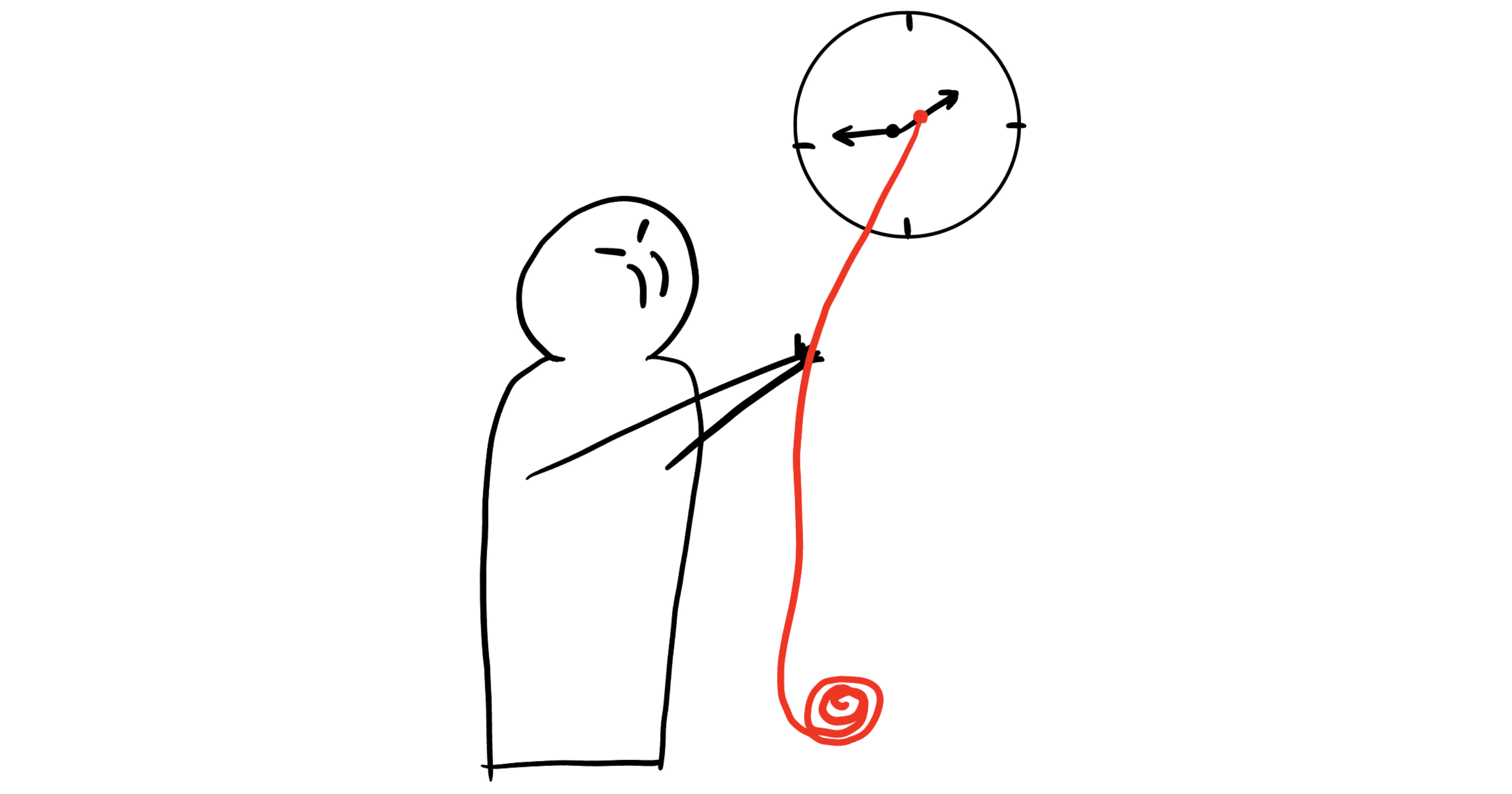
Delays do not change the destination. The car dealer’s inventory settles at the same equilibrium with or without delays. The relationship’s balancing loop points toward the same structural attractor.
What delays change is the path. The journey to equilibrium becomes oscillatory. And on that path, real damage accumulates. Inventory swings cost money, relationship oscillations erode trust, policy overcorrections create constituencies that fight the next correction.
In any system with delays, there are two separate problems: where is the system going? and what will the path there look like? Foundation 10 answered the first. Delays govern the second.
The most effective corrective action is often less action than feels right, sustained for longer than feels necessary. This does not necessarily mean that patience is a virtue. Because acting faster than the delay allows is indistinguishable from acting on fiction.
Same structure. Same loop. Same variables. Add a delay, get a different curve. The delay selects the behavior.
🧩 What’s Coming Next
This foundations series will build your systems thinking toolkit step by step:
2 | Stop! Let’s Talk Stocks: Not Wall Street, Just Bathtubs ✔️
3 | Go With the Flow: Pipes, Currents, and Traffic Jams (A Love Story) ✔️
4 | Causal Loop Diagrams 101: Stop Talking, Start Drawing ✔️
7 | Reinforcing Feedback Loops: Congratulations, You Made It Worse ✔️
10 | One-Stock System Dynamics: Choose Your Own Catastrophe ✔️
11 | Delays: Everything Is Fine (As of Six Months Ago) ✔️
12 | Two-Stock Systems: Now There Are Two of Them
📚 Main Resources
Meadows, D. H. (2015). Thinking in Systems. Chelsea Green Publishing.
Sterman, J.D. (2000) Business Dynamics: Systems Thinking and Modeling for a Complex World. Irwin McGraw-Hill, Boston.
My lecture notes from “System Dynamics” and “Simulation” classes :)
Some explanations and phrasings closely follow or directly quote these sources. The text was refined for coherence and citation accuracy with the assistance of large language models.