

System Dynamics | Foundation 7: Reinforcing Feedback Loops
Congratulations, You Made It Worse

In 2001, the dot-com bubble had just burst. Amazon’s stock had fallen 90% from its peak. Analysts were writing obituaries. Jeff Bezos invited business strategist Jim Collins to Seattle, and in a meeting with his executive team, Bezos sketched a diagram on a napkin.
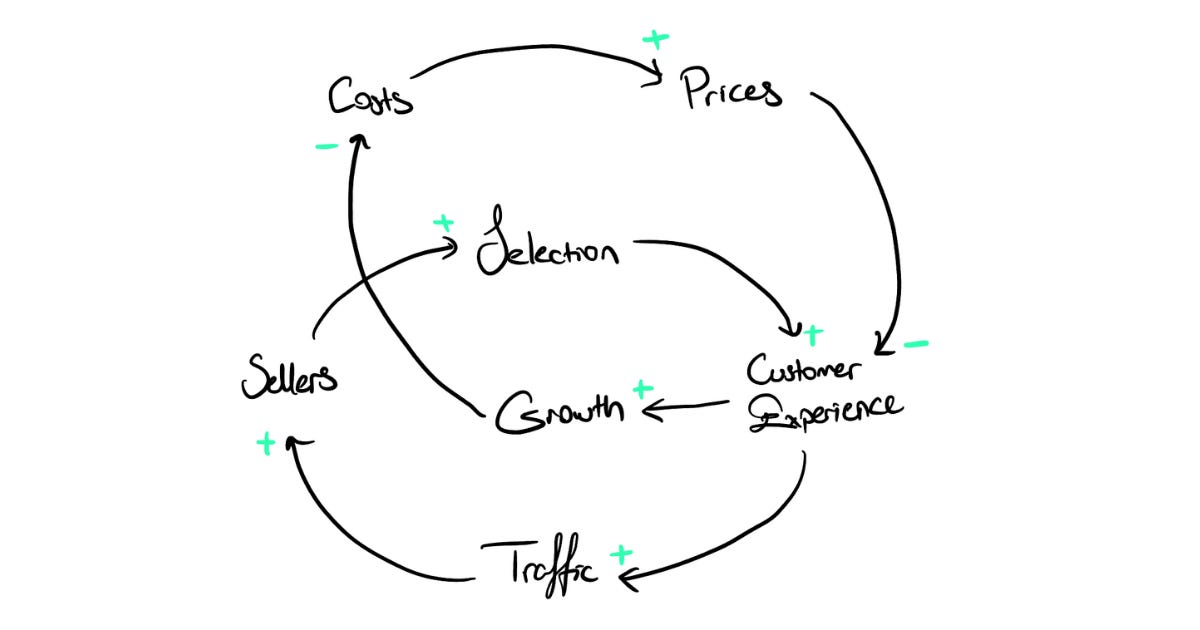
He said, more traffic attracts more sellers. More sellers expand selection. A wider selection improves the customer experience, which drives growth. Growth lowers costs through economies of scale. And here's where it gets interesting: lower costs lead to lower prices. Costs go down, prices go down, they move in the same direction -this is why we have “+” in the link. Lower prices pull in more customers, more customers bring more traffic, and the whole loop starts again. Each turn of the cycle makes the next turn easier.
That napkin described a reinforcing feedback loop. Today Amazon’s annual revenue exceeds $600 billion.
Now consider a different story. It’s 1930. A rumor spreads that a bank is in trouble. A few depositors withdraw their savings. Others see the line forming and get nervous. They withdraw too. The line grows. The evening news reports it. More people show up the next morning. The bank, perfectly solvent at sunrise, runs out of cash by noon. The rumor was false when it started. But the withdrawals it triggered made it true.
One story we call visionary strategy. The other we call a catastrophe. Underneath, the structure is identical. A change in one direction triggers forces that push further in the same direction. More leads to more. Less leads to less.
This is a reinforcing feedback loop. It is the second fundamental feedback structure in systems thinking, and it explains why some things grow beyond all expectation and why others collapse faster than anyone predicted.
What Is a Reinforcing Feedback Loop?
In Foundation 6, we met balancing feedback loops, the goal-seekers. They detect a gap between where things are and where they “should” be, and they push to close it. In general, they stabilize.
A reinforcing feedback loop does the opposite. It has no goal or target. No equilibrium it’s trying to reach. Instead, it takes whatever is already happening and makes more of it happen. If a stock is growing, a reinforcing loop accelerates the growth. If a stock is declining, a reinforcing loop accelerates the decline. It enhances whatever direction of change is imposed on it. In diagrams, reinforcing loops are marked with an R.
A balancing loop opposes change. A reinforcing loop amplifies it. Balancing loops are the brakes. Reinforcing loops are the accelerator. And unlike the brakes, the accelerator doesn’t know -or care- whether you’re headed toward a cliff.
Reinforcing Loops Amplify
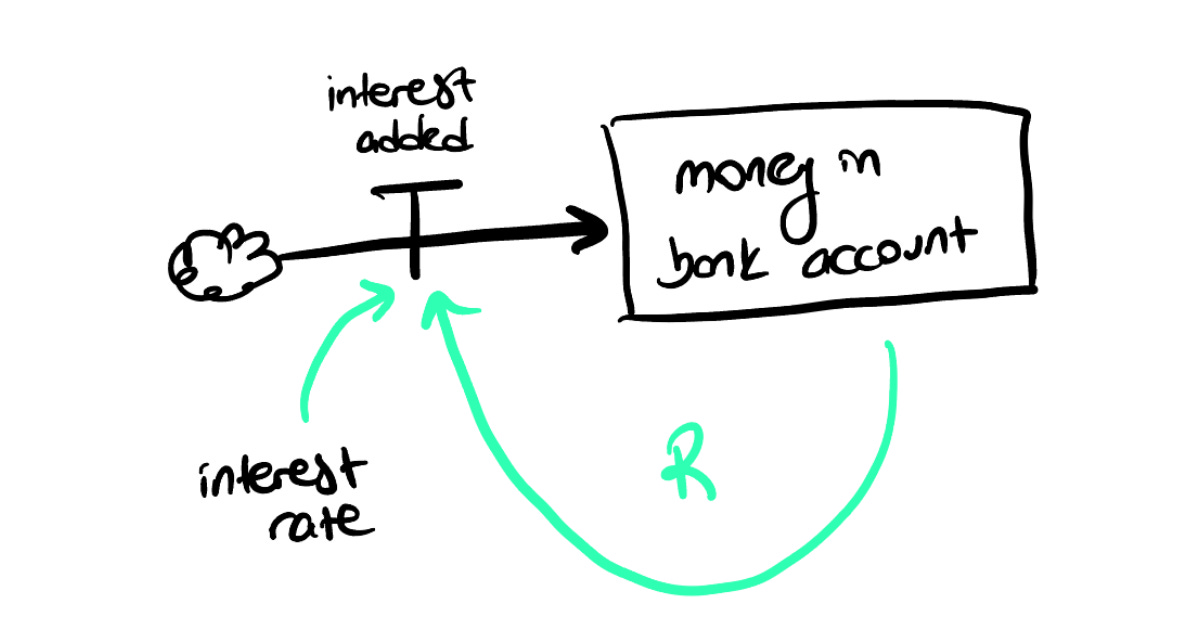
Imagine you put $100 into a savings account that earns 6% annual interest. At the end of the first year, you have $106. That interest was earned on $100. But at the end of the second year, you earn interest on $106 which gives you $112.36. The next year, interest is calculated on your $112.36 base.
The more money in the account, the more interest it earns. The more interest it earns, the more money is in the account. The stock feeds its own inflow.
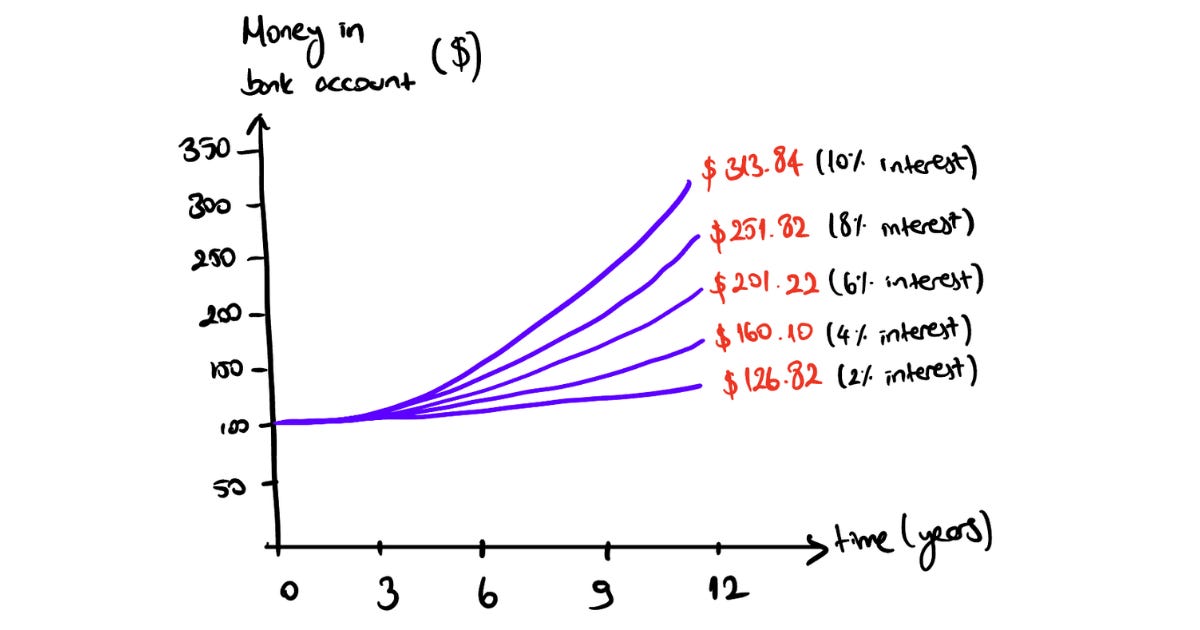
It doesn’t increase by the same amount each year, in other words it is not linear growth. It increases by a growing amount each year. After 12 years at 10%, that original $100 becomes $314 without a single additional deposit. The curve bends upward, which is the signature of a reinforcing loop.
The pattern shows up far beyond bank accounts. The more people speak English as a second language, the more useful it becomes to learn English. The more useful it becomes, the more people learn it. No international committee decided English would dominate global business, aviation, and scientific publishing. A reinforcing loop did. Each new speaker made the next speaker more likely.
In every case, the same signature: the stock feeds its own inflow. The more there is, the more gets added.
Reinforcing Loops Are Direction-Agnostic
Many people split examples into two neat buckets: “virtuous circles” (good outcomes) and “vicious circles” (bad outcomes). This framing may be comfortable but is certainly misleading.
A reinforcing loop doesn’t know whether its outcome is “good” or “bad” -also good or bad to whom. It amplifies whatever direction is already underway. The exact same structure that produces spectacular growth can produce devastating collapse. The only difference is which direction the loop is running when it starts.
Consider two cities.
In 1950, Detroit was the fourth-largest city in the United States, with 1.85 million residents and the highest per-capita income of any major American city. The auto industry was booming. Talent flowed in because opportunities were abundant. Opportunities were abundant because talent was flowing in.
Then the auto industry contracted. Factories closed. Workers left. Their departure shrank the tax base. Fewer tax dollars meant worse schools, worse infrastructure, fewer services which gave the next wave of residents a reason to leave. Which shrank the tax base further. By 2013, Detroit filed for the largest municipal bankruptcy in American history. Its population had fallen more than 60%.
Now look at Austin, Texas over roughly the same period. A few tech companies set up offices. Engineers moved in. Their presence attracted more companies. More companies attracted more engineers. More engineers meant more startups, more culture, more reasons for the next person to move there. Austin’s population more than tripled between 1980 and 2020.
Same loop. Same structure. Talent attracts opportunity, opportunity attracts talent. In Detroit, the loop ran in reverse. In Austin, it ran forward. Neither city “decided” its fate. The reinforcing loop decided it for them.
Calling Detroit’s decline “vicious” and Austin’s growth “virtuous” describes how we feel about the outcomes. It says nothing about the structure. The structure, amplification, was identical in both cases. If you want to change the outcome, you don’t need a different loop. You need to change the direction.
The same principle holds in ecology. When vegetation is cleared, soil loses the roots that hold it in place. Erosion strips more soil, which means less can grow, which means fewer roots, which means more erosion. Run the same loop in the other direction: more vegetation builds deeper roots, holds more soil, supports more growth. The Dust Bowl and the Amazon rainforest are the same feedback structure pointing in opposite directions.
The Doubling Time Trap
If reinforcing loops are so powerful, why do they keep catching us off guard?
Because human brains are wired for linear extrapolation. We see 2, 4, 6, and we predict 8. But reinforcing loops don’t produce 2, 4, 6, 8. They produce 2, 4, 8, 16, 32, 64. The difference feels small at first and then suddenly, it doesn’t.
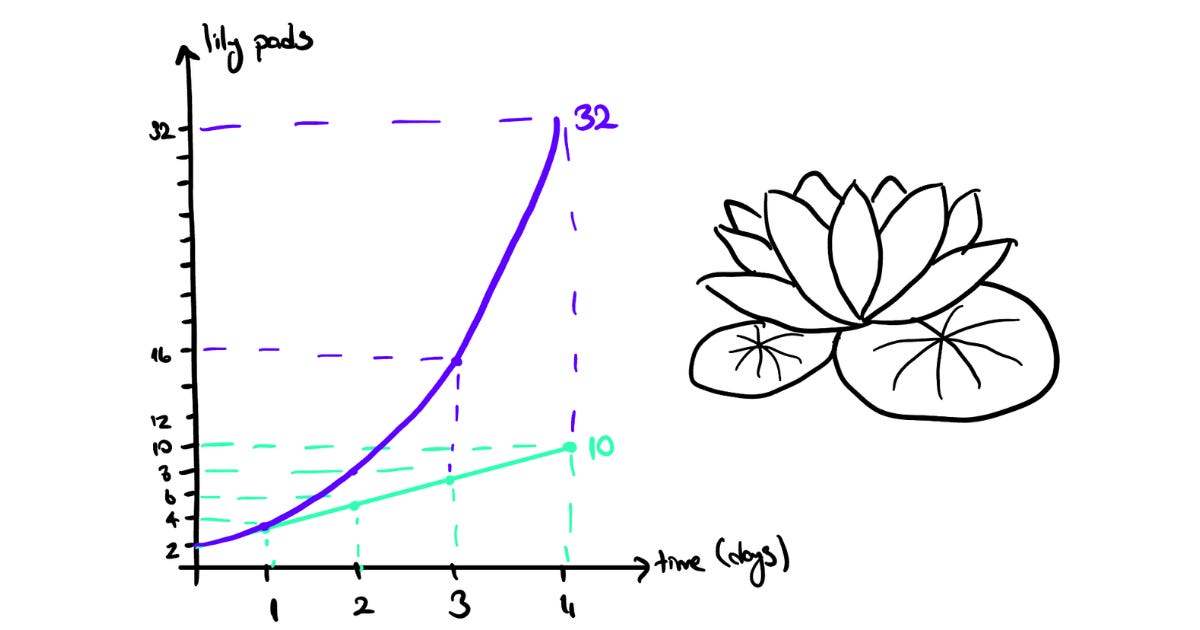
There’s a famous riddle that captures this. A lily pad sits on a pond. Every day, it doubles in area. On Day 30, it covers the entire pond. On what day does it cover half the pond?
Most people guess Day 15 but the answer is Day 29.
Even if you know the answer, you have to admit that you heard the voice in your head that shouts as “Day 15.” It is because we intuitively divide the process in half: half the coverage should take half the time. But exponential growth doesn’t work that way. The pond goes from half-covered to fully covered in a single day.
This is exactly why the early spread of COVID-19 blindsided the world, except infectious disease specialists. In late January 2020, there were fewer than 10,000 confirmed cases globally. That felt manageable to decision makers. Two months later, there were over a million. Each infected person infected others, who infected others, a reinforcing loop, but our monkey brains kept forecasting linearly. “It’s only 200 cases” felt reassuring because we imagined 200, 400, 600, 800. The actual trajectory was 200, 400, 800, 1,600, 3,200. By the time exponential growth feels fast, it’s already everywhere. The reinforcing loop was running from Day 1. Our ancient intuition just couldn’t see the curve.
This mismatch between linear thinking and exponential reality is arguably the most dangerous cognitive blind spot we humans have. It’s why bubbles surprise us. It’s why pandemics outrun us. It’s why compound interest is called the eighth wonder of the world by people who understand it, and ignored by people who don’t.
If Nothing Grows Forever, What Stops a Reinforcing Loop?
If reinforcing loops just keep amplifying, why doesn’t everything either grow to infinity or collapse to zero?
Because in the real world, reinforcing loops never operate alone.
The rabbit population doesn’t actually grow forever. Eventually, food runs out or predators multiply. Disease spreads through overcrowded warrens. Each of these is a balancing loop that kicks in as the stock grows, pushing back against the reinforcing loop, slowing it, eventually stopping or reversing the growth. Amazon’s flywheel doesn’t spin without friction. Markets saturate and regulators step in, or maybe competitors adapt. Even the savings account hits limits inflation erodes real value, or banks change rates and taxes take a cut.
The real world is never purely R, and it’s never purely B. It is always a combination of reinforcing and balancing loops interacting, amplifying and constraining, pushing and pulling, often within the same system, at the same time. Which loop dominates at any given moment determines the behavior you observe. Growth, decline, oscillation, stagnation. All of these emerge from the tug-of-war between R and B.
That interaction is where system behavior gets truly interesting. And that’s where we’re headed next.
Why Should You Care?
You are inside several reinforcing loops right now. Your career momentum is one. Past successes create opportunities for future ones, which create visibility, which creates more opportunities. Your debt is one. Unpaid interest adds to the principal, which generates more interest. Your knowledge in any field is one. The more you know, the faster you absorb new information, which accelerates how much you know.
These loops are running whether you see them or not. The question isn’t whether they’re good or bad but it’s which direction they’re moving, and whether you noticed before the curve bent.
When something is spiraling, up or down, the instinct is to look for someone to blame. A bad CEO. A lazy team. A corrupt government. An unlucky break. These explanations feel satisfying because they point to a person, an event. They give you a villain.
But if the behavior is produced by a reinforcing feedback loop, replacing the person changes nothing. The structure will produce the same trajectory with different faces. Detroit didn’t decline because of one bad mayor. The banking system didn’t collapse because of one reckless bank. The loop was running. It would have run with anyone in the chair.
If you want to change the outcome, you have to see the loop. Find the stock that’s feeding its own inflow or accelerating its own outflow. Find the point where a small intervention can reverse the direction, or where a balancing loop can be introduced to constrain the amplification before it’s too late.
Blaming is easy compared to seeing the structure. But only one of them actually changes anything.
So far, we’ve studied balancing and reinforcing loops in isolation. Clean, separate, easy to follow. But the real world doesn’t hand you one loop at a time. Real systems are tangles, reinforcing loops driving growth while balancing loops constrain it, multiple loops pulling a single stock in different directions, feedback structures so intertwined that the same action can trigger growth in one part of the system and collapse in another.
That’s where we go next. Not R or B in isolation, but what happens when they collide.
👋🏽 Before You Go
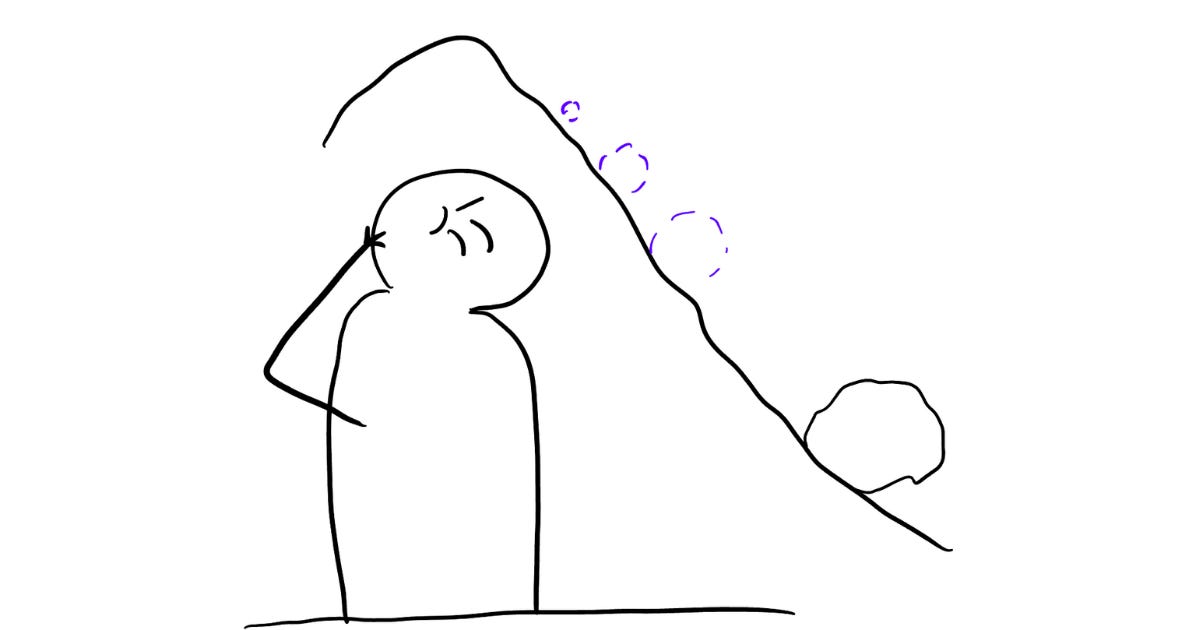
Next time something in your life is accelerating -your workload, your network, your reputation, your debt- pause. Don’t ask “who caused this” and blame. Ask instead: what is feeding itself here? Find the stock. Find the flow. Trace where the output loops back into the input. That’s your reinforcing loop. And once you see it, you can decide whether to amplify it or break it.
🧩 What’s Coming Next
This foundations series will build your systems thinking toolkit step by step:
2 | Stop! Let’s Talk Stocks: Not Wall Street, Just Bathtubs ✔️
3 | Go With the Flow: Pipes, Currents, and Traffic Jams (A Love Story) ✔️
4 | Causal Loop Diagrams 101: Stop Talking, Start Drawing ✔️
7 | Reinforcing Feedback Loops: Congratulations, You Made It Worse ✔️
📚 Main Resources
Meadows, D. H. (2015). Thinking in Systems. Chelsea Green Publishing.
Sterman, J.D. (2000) Business Dynamics: Systems Thinking and Modeling for a Complex World. Irwin McGraw-Hill, Boston.
My lecture notes from “System Dynamics” and “Simulation” classes :)
Some explanations and phrasings closely follow or directly quote these sources. The text was refined for coherence and citation accuracy with the assistance of large language models.