

System Dynamics | Foundation 8: One-Stock Systems
The Minimum Viable Drama

By the end of this article, you’ll understand why your most frustrating relationship follows the same structural logic as your heating system. That’s not a metaphor. It’s the same system. But we need to start somewhere simpler. We need to start with the most boring system in the world.
The Thermostat
You already know how a thermostat works. Or at least you think you do.
Let’s slow down and look at what’s really happening. Because there’s more going on than most people realize.
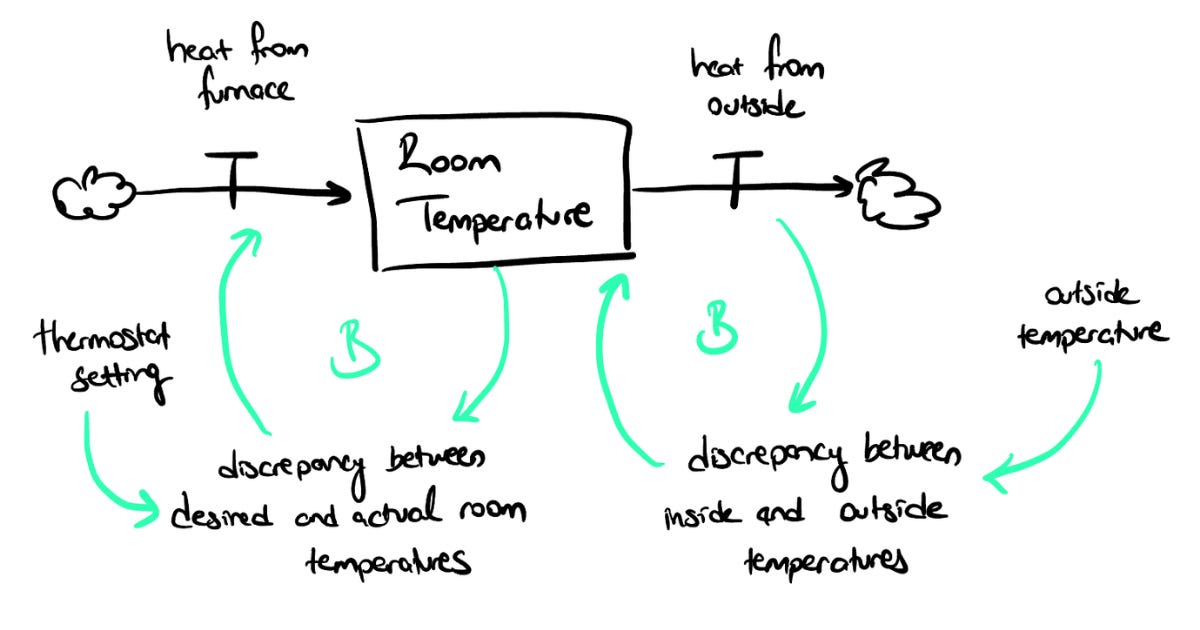
A thermostat regulates the temperature of a room. The temperature of the room is our stock, the thing that accumulates, the thing we can measure at any point in time.
Two forces are pulling on this stock. Two loops. Each one trying to drag the room temperature toward a different goal.
The heating loop. The thermostat has a setting. Let’s say, 18°C. When the room temperature drops below that setting, there’s a gap. The thermostat detects the gap and signals the furnace to fire. Heat flows into the room. The temperature rises. The gap closes. This is a balancing loop. Its goal is the thermostat setting.
The cooling loop. Heat leaks through the walls. Through the windows. Through every crack and imperfection in the building’s insulation. This heat leak is always trying to make the room temperature equal to the outside temperature. The bigger the gap between inside and outside, the faster the leak. This is also a balancing loop. Its goal is the outside temperature.
One stock. Two balancing loops. Two different goals.
Now here’s the first thing most people miss.
The stock never lands where either loop wants it
When both loops operate at the same time, the room temperature doesn’t settle at the thermostat setting. It settles slightly below it.
Why? Because heat is always leaking. Even as the furnace pumps heat in, some of it escapes. The furnace compensates, cycles on and off, and the room holds near the target, but not exactly at it.
Think of it as trying to fill a bucket that has a hole in the bottom. You can keep the water level high, but it will always sit a little below the rim. The leak never stops.
This is important enough to state as a principle:
In a system with competing loops, the stock settles at a compromise point determined by the relative strength of the loops. The stronger loop pulls the stock closer to its goal, but never perfectly to it.
This principle has immediate practical implications. If you want the room at 18°C, set the thermostat slightly above 18°C. If you want to maintain a workforce of 100 people, you need to hire fast enough to compensate for the attrition that’s draining your headcount while you’re hiring. If you don’t account for the opposing loop, you will always miss your target and wonder why.
Dominance shifts
Now let’s watch what happens over a full day.
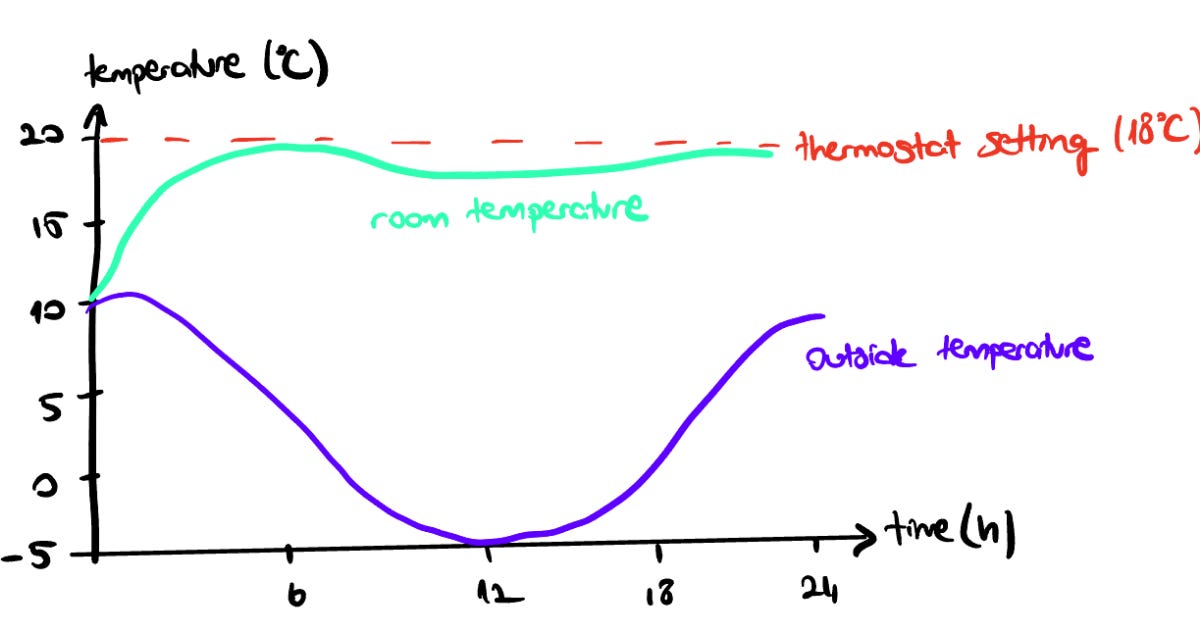
This is a well-functioning system. Good insulation. Strong furnace. The heating loop dominates the cooling loop, and the room temperature barely flinches, even as the outside temperature drops well below freezing.
But what if the house is leaky?
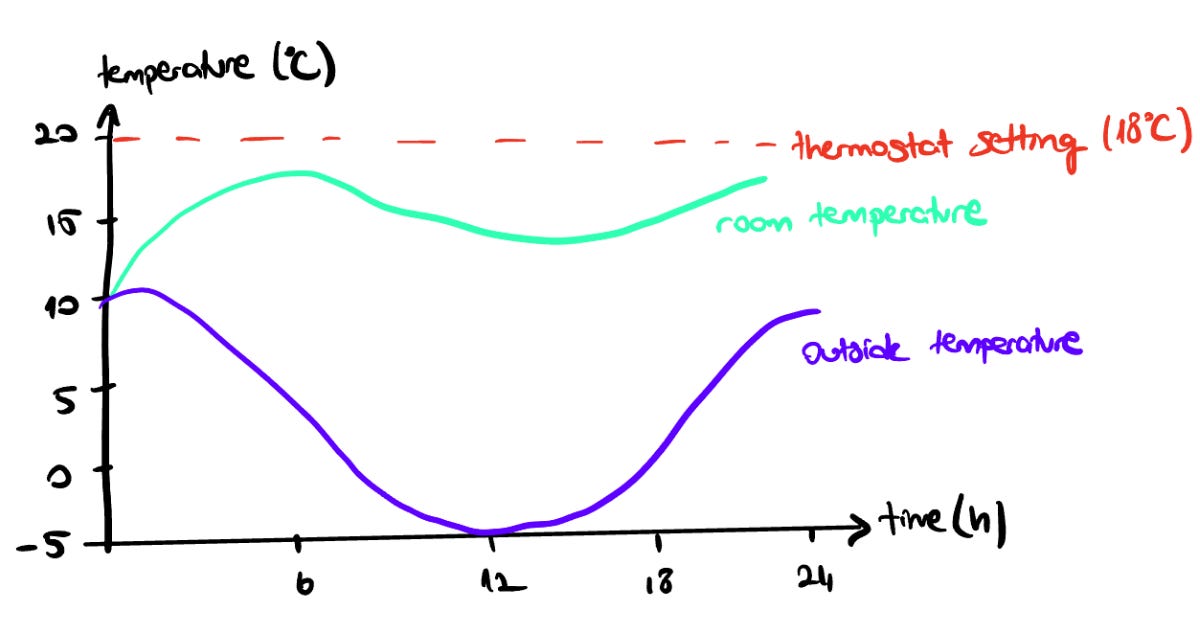
Same furnace. Same thermostat setting. But with poor insulation, the cooling loop overwhelms the heating loop. When the outside temperature drops hard enough, the furnace simply cannot replace heat as fast as it escapes.
The furnace didn’t break. The thermostat didn’t malfunction. The relative strength of the two loops shifted, and the system’s behavior changed dramatically.
This is the concept of dominance, whichever loop is stronger at a given moment determines the system’s behavior. And dominance can shift as conditions change.
Every balancing loop has a breakdown point
The moment the opposing loop pulls the stock away from the goal more strongly than the corrective loop can pull it back. That’s the breakdown point.
For a thermostat, it’s a cold enough night with poor enough insulation. The furnace runs at full blast and the room still gets cold.
This is not a rare phenomenon. Every balancing loop in every system has this threshold. Every budget has a spending rate that overwhelms it. Every customer service team has a complaint volume it can’t absorb. Every immune system has a viral load it can’t suppress.
The structure tells you the breakdown point exists. The only question is where.
One more thing about feedback
There’s a property of feedback loops that seems obvious once you hear it but changes how you think about systems.
Feedback can only affect future behavior.
The thermostat reads the current room temperature and adjusts the furnace. But the furnace’s response doesn’t fix the heat that already leaked. It only affects what happens next. There is always a delay between sensing the gap and closing it.
This is why the room overshoots and undershoots. This is why you can’t steer a car by looking only at where you are right now, you steer based on where you’re going. This is why economic models that assume instant response to price changes fail to match reality.
Every feedback loop has this property. And when we forget it, we get surprised by a system doing exactly what its structure predicts.
The Structure Is the Story
This is one of the central insights of systems thinking.
Systems with similar feedback structures produce similar dynamic behaviors, even if the outward appearance of these systems is completely dissimilar.
A thermostat is nothing like a relationship, except that both have two forces pulling the same stock toward different goals, settling at a compromise that satisfies neither.
The surface doesn’t matter. The structure does.
Once you internalize this, you start seeing familiar architectures in unfamiliar places. And the most powerful recognition is when you see the thermostat, which has two competing balancing loops, one stock, a compromise that satisfies no one, in places you never expected.
Your relationship is a thermostat
Let's test this. Let's take something that looks nothing like a thermostat and see if the structure holds. Consider two people in a relationship. One is anxiously attached. The other is avoidantly attached.
The stock is emotional closeness between them.
The anxious partner has a setpoint for closeness. When distance grows such as fewer texts, less quality time, emotional withdrawal, they detect a gap. Corrective action kicks in in a way that they reach out, initiate plans, seek reassurance, express needs. The goal is connection. This is a balancing loop.
The avoidant partner has a different setpoint. When intimacy intensifies, like too many calls, too much emotional demand, too much togetherness, they detect a gap too. Their corrective action become as they pull back, need space, withdraw, create distance. The goal is independence. This is also a balancing loop.
Two balancing loops. One stock. Two different goals.
The relationship settles at a level of closeness that neither person is fully satisfied with. The anxious partner always wants a little more. The avoidant partner always wants a little less. The stock sits at a compromise, just like the room temperature that never quite reaches the thermostat setting.
When life is calm, both loops operate at manageable strength. The system holds. Imperfect but stable.
But when stress enters -a job loss, a health scare, a family crisis- the anxious partner’s loop intensifies. They need more reassurance. More closeness. The gap feels unbearable.
The avoidant partner, now overwhelmed by the increased demand, pulls back harder. Their loop intensifies too.
Dominance shifts.
And if the anxious partner’s pursuit overwhelms the avoidant partner’s capacity, or the avoidant partner’s withdrawal overwhelms the anxious partner’s tolerance, the system hits its breakdown point.
The furnace can’t keep up with the cold.
Millions of people experience this dynamic. Shelves of books have been written about attachment styles. Entire therapeutic frameworks exist to address it.
And it’s a thermostat. Not a failure of love. Not a failure of character. A structural pattern producing predictable behavior, because that’s what the feedback architecture dictates.
Try It Yourself
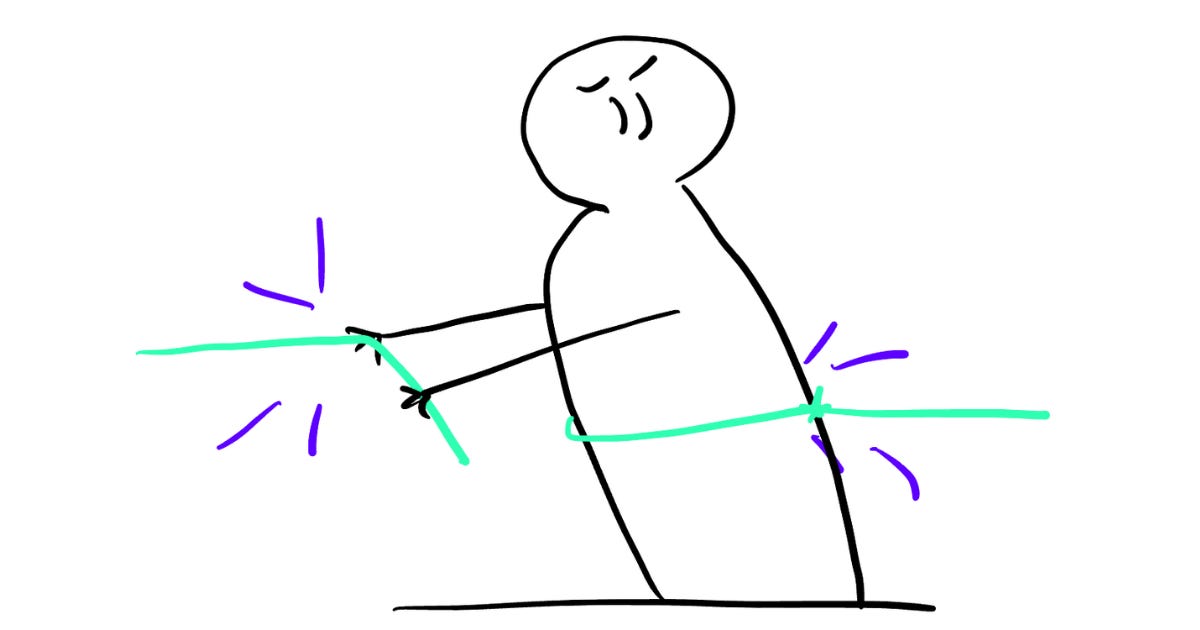
Think about a system in your own life where two forces pull the same thing in different directions. It could be in your organization, your health, your community, your family.
Ask yourself:
What is the stock? What’s the thing being pulled?
What are the two loops? What goal is each one seeking?
Where does the stock settle? Is either loop getting exactly what it wants?
What would shift the dominance? What conditions would make one loop overwhelm the other?
Where is the breakdown point?
Once you start seeing this structure, you won’t be able to unsee it.
That’s what the thermostat teaches. Not how heating works — but how the world works.
🧩 What’s Coming Next
This foundations series will build your systems thinking toolkit step by step:
2 | Stop! Let’s Talk Stocks: Not Wall Street, Just Bathtubs ✔️
3 | Go With the Flow: Pipes, Currents, and Traffic Jams (A Love Story) ✔️
4 | Causal Loop Diagrams 101: Stop Talking, Start Drawing ✔️
7 | Reinforcing Feedback Loops: Congratulations, You Made It Worse ✔️
📚 Main Resources
Meadows, D. H. (2015). Thinking in Systems. Chelsea Green Publishing.
Sterman, J.D. (2000) Business Dynamics: Systems Thinking and Modeling for a Complex World. Irwin McGraw-Hill, Boston.
My lecture notes from “System Dynamics” and “Simulation” classes :)
Some explanations and phrasings closely follow or directly quote these sources. The text was refined for coherence and citation accuracy with the assistance of large language models.