

System Dynamics | Foundation 1: System
Everything, Everywhere, All at Once: That’s a System

If a factory is torn down but the rationality which produced it is left standing, then that rationality will simply produce another factory. If a revolution destroys a government, but the systematic patterns of thought that produced that government are left intact, then those patterns will repeat themselves… There’s so much talk about the system. And so little understanding.
-Robert Pirsig, Zen and the Art of Motorcycle Maintenance (my fav book)
What’s “System”?
System: A meaningful, invisible collection or whole of interacting components.
Walk into a coffee shop on a busy morning. Customers flow in and out, baristas call out orders, the espresso machine hisses, money changes hands. It feels chaotic, but watch for a few minutes and you’ll notice something: there’s an invisible choreography at work. This isn’t just a random collection of people and objects, it’s a system.
A system is an interconnected set of elements that is coherently organized in a way that achieves something. It’s a meaningful whole, often invisible, made of interacting components that work together toward some end.
Systems Hide in Plain Sight
Once you start looking for systems, and if you know where to and how to look, it’s easy to spot them. YouTube is a system where video content, viewers, algorithms, comments, and shares interact through watch time and engagement to maximize ad revenue. A rock band is a system where drummer, bassist, guitarist, and vocalist coordinate through rhythm and musical cues to create cohesive music. Traffic is a system. So is a forest, a basketball team, and an economy.
Also, systems can nest within systems. An animal is a system, but it’s also part of the larger ecosystem. A tree is a system of roots, trunk, and leaves, but it’s also an element in the forest system. Your body is a system, but so is each organ within it. Climate is a system, so the earth.
When a Collection Isn’t a System
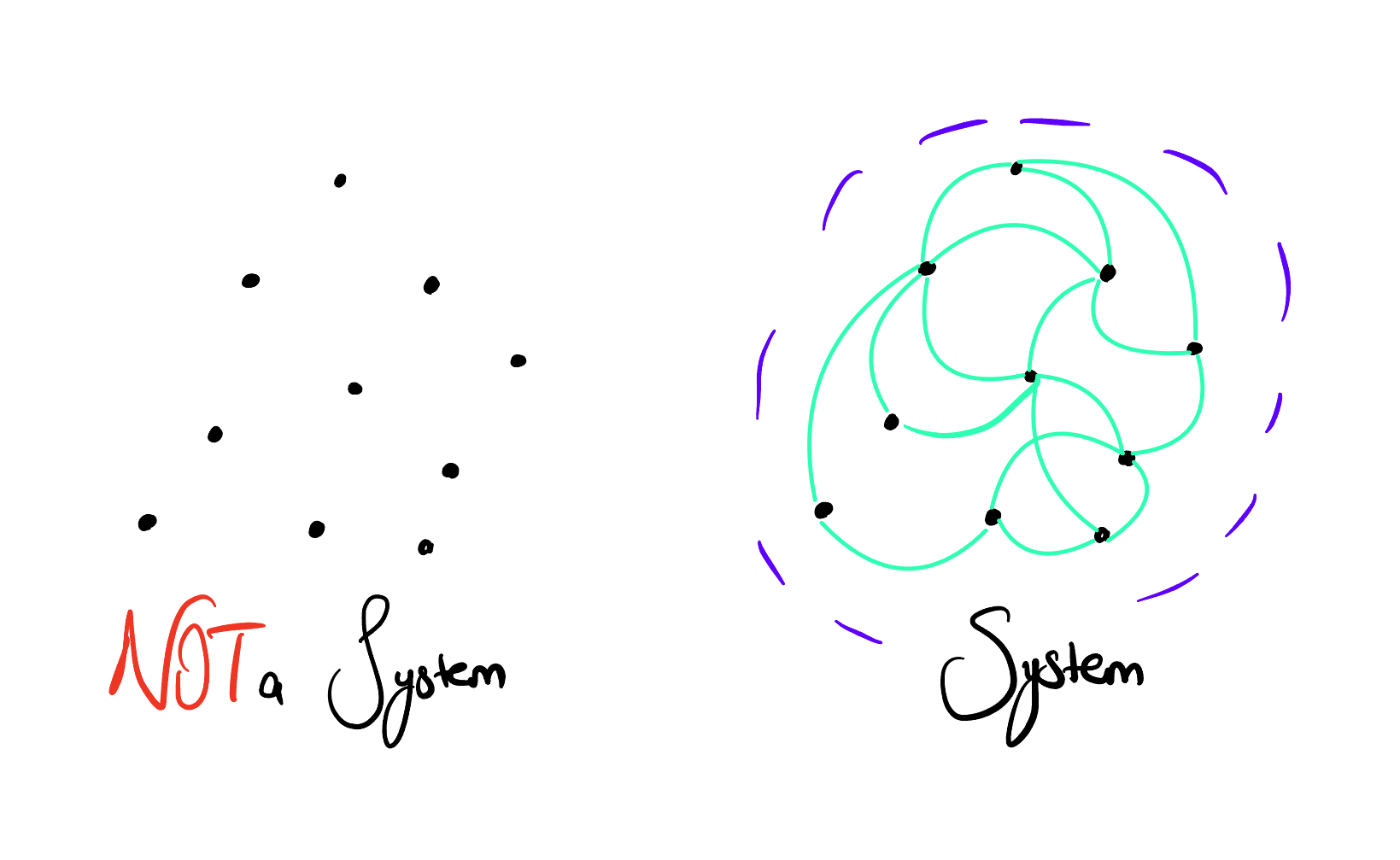
Not everything that looks like a group qualifies as a system. A heap of rocks sitting together is just that, a heap. The rocks don’t meaningfully interact. Moving one doesn’t influence the others. Their arrangement serves no purpose. There are no feedback loops, no interdependencies, just rocks placed together by chance or convenience.
A true system has integrity, a sense of wholeness. It has active processes working to maintain that integrity. Systems adapt, react to changes, and pursue goals. Systems can be self-organizing, and often are self-repairing over at least some range of disruptions. When a living organism dies, it loses that integrity, its “system-ness” disappears, leaving behind just a collection of parts.
Three Lenses for Understanding Systems
To truly identify and understand systems, you need to look through three different lenses: elements, interconnections, and purpose.
The Visible Parts: Elements
Start with what’s easiest to see, the elements. In a beehive, these include the queen bee, worker bees, drone bees, larvae, honeycomb, and honey stores. In a university, you’ll find buildings, students, professors, administrators, libraries, and laboratories.
But here’s where it gets tricky: not all elements are tangible. Due to your system’s boundaries, a university’s academic reputation might matters just as much as its buildings. School spirit influences behavior even though you can’t hold it in your hand.
You could spend forever cataloging elements. Each bee contains its own subsystems: brain, sensory organs, wings, digestive system. Each student carries a smartphone with its own subsystems of circuits and software. At some point, you lose sight of the forest for the trees. So, it’s important to have a clear boundaries for your system. The elements alone don’t tell you much about how the system actually works.
The Hidden Web: Interconnections
This is where systems get interesting. Interconnections are the relationships and interactions that bind elements together, and they’re much harder to observe than the elements themselves.
Consider that beehive again. The queen releases a scent throughout the hive, signaling her health and presence. This chemical message prevents worker bees from raising a replacement queen. But if her scent weakens, workers immediately respond by feeding royal jelly to certain larvae. When the hive gets too hot, bees fan their wings and bring water for evaporative cooling. When it’s cold, they cluster and vibrate their flight muscles to generate heat, which signals others to maintain the cluster.
Many interconnections involve flows of information, signals that trigger decisions or actions. Students choose courses based on informal information about which professors give good grades. Consumers make purchases based on their income and knowledge of prices. Governments create policies based on data about population and resources. These information flows are invisible but absolutely critical to how systems operate.
The Most Elusive: Purpose
If interconnections are difficult to observe, purposes are even more hidden. A system’s purpose is rarely written down or formally stated. Instead, it’s revealed through the system’s actual behavior over time.
If a whale migrates north and south year after year, its purpose isn’t about the direction it travels but about accessing seasonal feeding grounds and safe breeding areas. If a government claims to value freedom of speech but doesn’t allocate resources to protect it, then freedom of speech isn’t truly that government’s purpose. Actions reveal purpose, not rhetoric.
The function of an immune system is to protect the body from disease and injury. The function of a thermostat is to maintain room temperature within a desired range. The function of a music group is to produce songs. The function of Rockstar is to (yes, you guessed it correctly) delay the release of GTA VI -last one was not really scientific, I know.
System purposes don’t have to be human purposes. In fact, one of the most frustrating aspects of systems is that the purposes of subunits can add up to an overall behavior nobody wants. No one sets out to create a society with high drug addiction and crime, yet systems can produce exactly that outcome.
The Hierarchy of a System
Here’s a thought experiment: What happens when you change each aspect of a system?
Change the elements, and surprisingly little may shift. Your body constantly replaces cells, every few years, nearly all of them are new, yet you remain you -although Theseus may disagree. Students graduate and new ones enroll, but the university continues functioning much the same. Employees leave companies and new ones are hired, but the organization persists. As long as interconnections and purposes remain stable, systems maintain their identity even with complete turnover of parts.
Change the interconnections, and you get dramatic shifts. Keep all the same chess pieces but change the movement rules, and you no longer have chess, you have a different game entirely. The pieces are the same, but the system behaves completely differently.
Change the purpose, and the transformation becomes even more radical. Imagine playing chess with the same pieces and rules, but now your goal is to deliberately lose rather than win. The system would be unrecognizable in how it operates, even though nothing about the physical elements or rules changed.
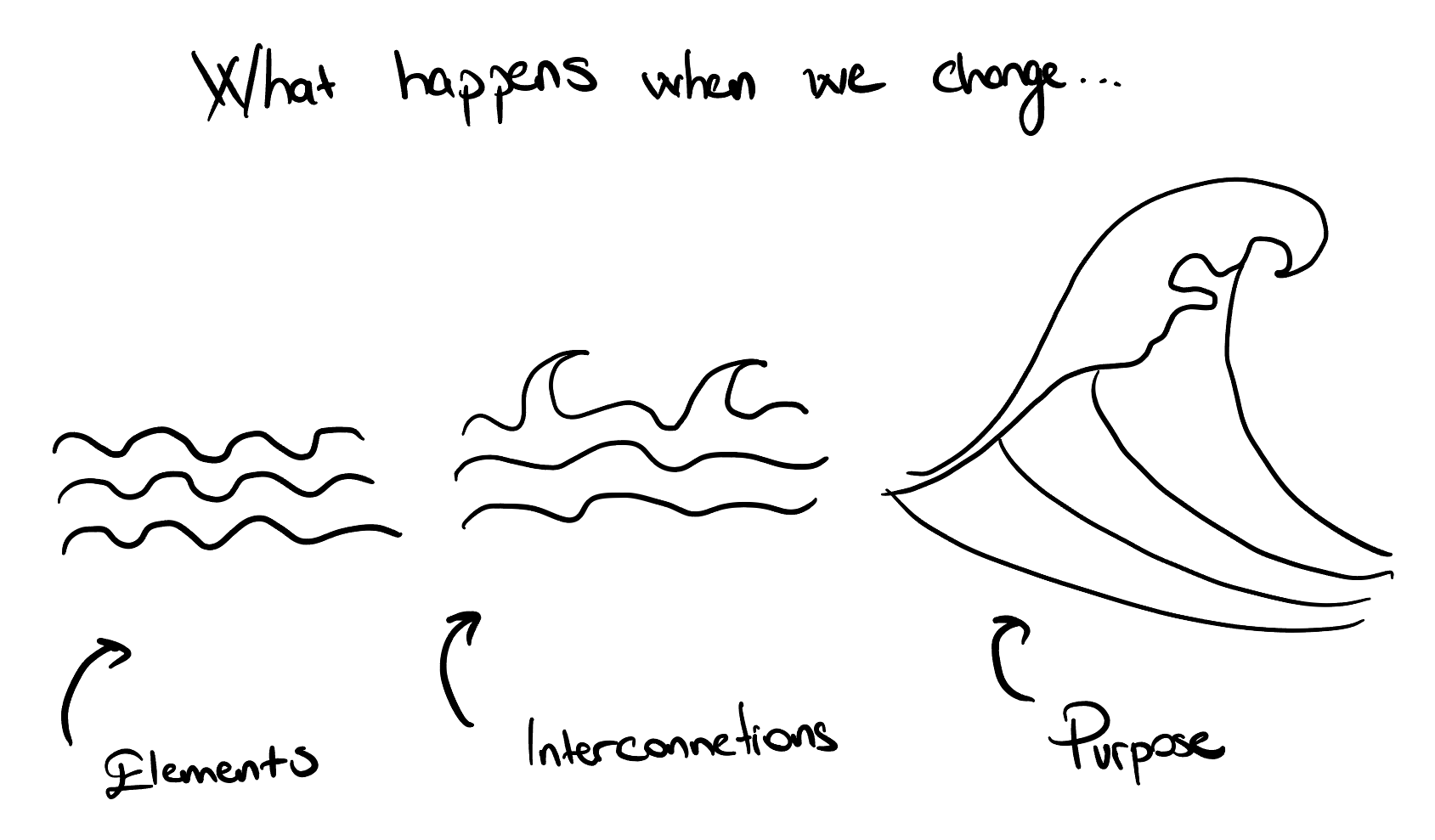
This reveals something counterintuitive. The least visible part of a system, its purpose, often has the most powerful influence on behavior. Interconnections come next in importance, as changing relationships typically changes how the system operates. The elements, despite being the most easy components to see, matter least in defining what makes a system unique. (Unless, of course, changing the elements also changes the relationships or purpose that hold everything together.)
Why This Matters
This hierarchy, purpose over interconnections over elements, explains why so much effort at change fails. We replace CEOs, elect new politicians, hire consultants, restructure departments to eliminate corruption, bribery, or fraud. We’re changing elements, the most visible but least powerful lever. Meanwhile, the invisible web of relationships and the unspoken purposes continue driving the system exactly as before.
Real transformation requires changing what’s hardest to see and hardest to touch. The patterns of interaction between parts, and the actual goals the system pursues regardless of what anyone claims those goals to be. A new leader matters only insofar as they can shift these deeper layers. Without that, you’ve simply swapped one piece for another while the game continues unchanged.
Understanding systems means understanding this: the most powerful forces are often invisible, and the most visible changes often accomplish the least.
👋🏽 Before You Go
The next time you want to change a system, whether it’s your relationship, or your own habits, ask yourself: Am I just rearranging the pieces? Or am I changing how they interact and what they’re actually trying to accomplish?
🧩 What's Coming Next
This foundations series will build your systems thinking toolkit step by step:
📚 Main Resources
Meadows, D. H. (2015). Thinking in Systems. Chelsea Green Publishing.
Sterman, J.D. (2000) Business Dynamics: Systems Thinking and Modeling for a Complex World. Irwin McGraw-Hill, Boston.
My lecture notes from “System Dynamics” and “Simulation” classes :)
Some explanations and phrasings closely follow or directly quote these sources. The text was refined for coherence and citation accuracy with the assistance of large language models.