

System Dynamics | Foundation 18: Policy Resistance Archetype
Everyone Was Right

On where we are. The last three articles (resilience, self-organization, hierarchy) were about properties that working systems have. From here on the series turns to recognizable patterns of failure: the archetypes. This one is about what happens when two parts of a system disagree about what the system is for.
The birth rate didn’t move
In October 1966, Romania’s National Assembly passed Decree 770, which banned abortion and most contraception for women under forty who had fewer than four children. Ceaușescu had been in power for barely a year, and the policy he ratified through the Assembly was demographic in the most mechanical sense. The plan was a larger population to staff the factories, fill the conscription quotas, and broaden the tax base, all of it to be produced by closing the legal routes to having fewer children.
Romania’s total fertility rate, plotted year by year, sat at around 2.0 children per woman the year the decree was signed and at 3.7 the year after, which on a chart looks less like a curve than a vertical wall.
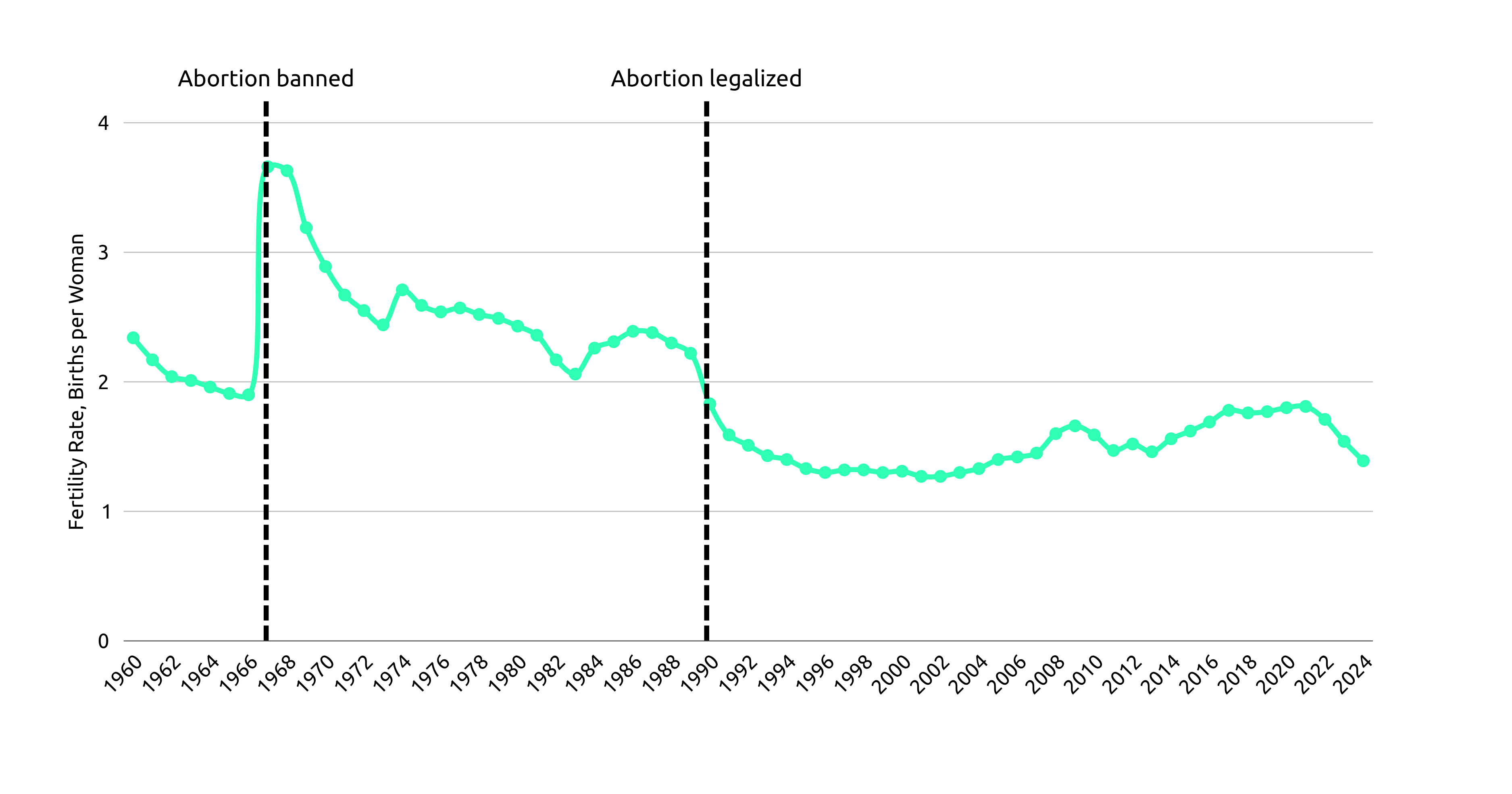
Then the wall begins to come down. By 1969 the rate has dropped back to 2.9, by 1973 to 2.7, and by the time Ceaușescu is dragged out of the National Assembly building and shot on Christmas Day 1989, the fertility rate has settled back near 2.2, within reach of where it had been before the decree was ever signed. None of this happened because the decree was relaxed; the decree never came off the books, enforcement intensified through the late seventies (compulsory gynecological exams, criminalized possession of contraception, maternal mortality climbing to the highest level in Europe) and the rate kept falling anyway.
The most natural explanation is that the population disobeyed. Romanian women defied the regime, obtained illegal abortions, smuggled contraception, hid pregnancies, and did whatever was necessary, and there is no question that they did all of these things. This is a true story I heard from the son of someone who lived through those days in Romania. According to what his father told him, since condoms were unavailable in the country, people used products like this that were constantly washed and reused.
But disobedience is a story about people, and the same shape of curve appears in places where people are not particularly defiant and against policies that do not particularly punish defiance, which means the story is true and incomplete in roughly the same way that “the patient ignored medical advice” is true and incomplete.
The structure of a standoff
Hold the chart in your head. What it tracks across thirty years is the birth rate, The number of births per woman per year shows a sharp increase, then drops again, and roughly returns to where it started. The birth rate is an auxiliary, not the stock; the stock is Population, the inflow is Births, and what both loops are contesting is the Births inflow that fills it.
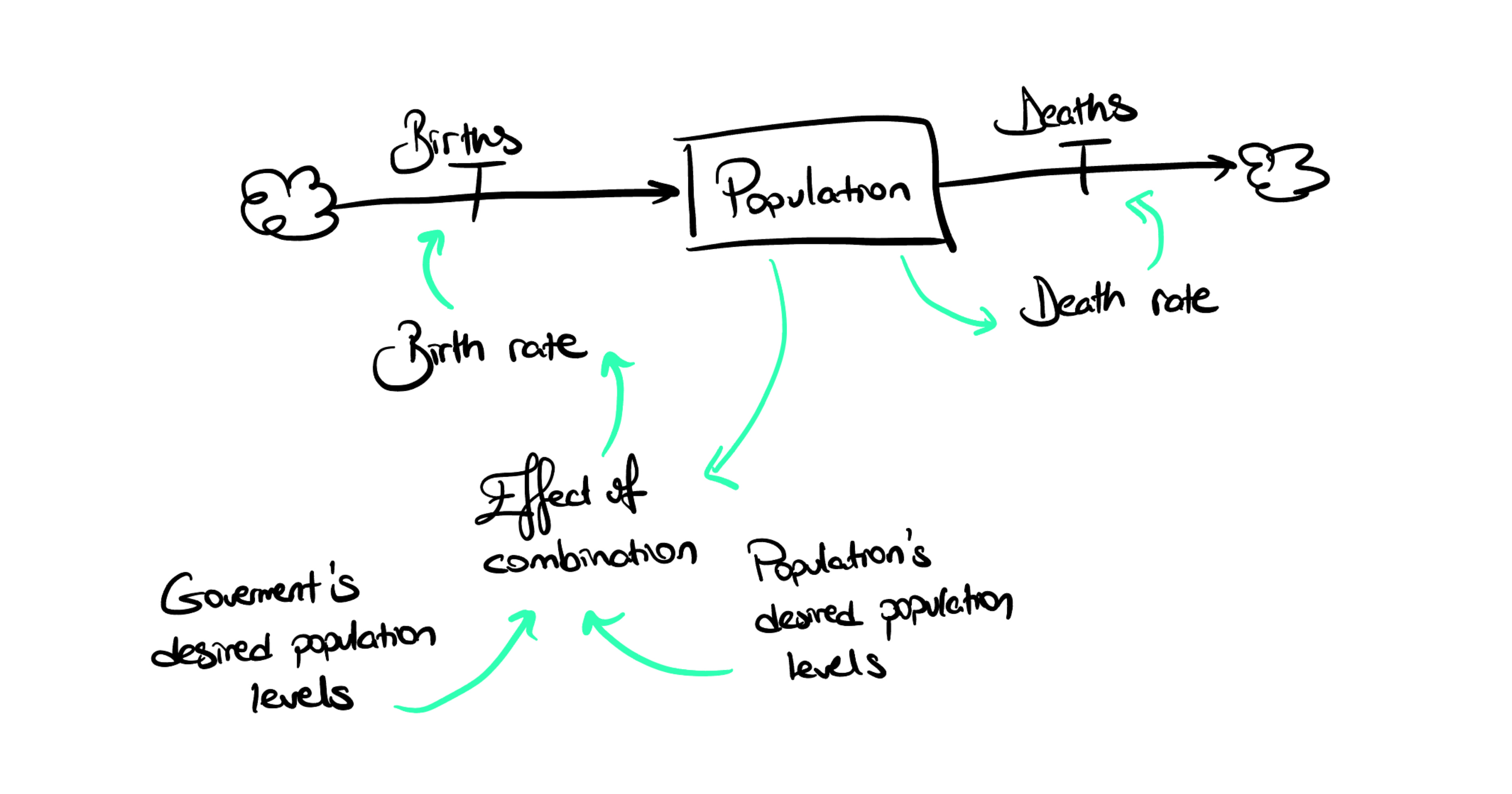
Now look at what is acting on the Births inflow. The government is operating a feedback loop. It has a goal for Population, which is for it to grow faster; it reads the trajectory through the birth rate; and it acts to raise the inflow through decrees, surveillance, and enforcement. The polarity of the loop is straightforward: the discrepancy between the government’s setpoint and the observed rate drives the corrective action, the corrective action raises the Births inflow, the inflow accumulates into the Population stock, and the stock reduces the discrepancy. This is a balancing loop in Meadows’ sense, every thermostat works the same way.
The population is operating a feedback loop too. Families have a goal for their own family size, which in 1966 was already substantially smaller than what the government’s policy now compelled. Romania was an industrializing country with rising female literacy and shrinking child mortality, and the demographic transition was already running. The population observes the gap between the family sizes the policy is now imposing and the ones individual families would otherwise have chosen, and acts. Illegal abortion networks form, contraception is smuggled across borders, information about herbal abortifacients moves through informal channels, doctors are bribed, and an entirely separate medical economy of midwives takes shape underneath the legal one. The corrective action lowers the Births inflow, which closes the gap. A balancing loop, like the government’s, but with its goal set at a different level. Each Romanian woman, taking her own situation as given, is doing exactly what someone in her position would do.
This is the main configuration. Two balancing loops, both rational, both correcting toward different setpoints, contesting the same Births inflow into the same Population stock. Meadows calls the rationality at work in each loop bounded rationality, by which she means that every actor is operating sensibly within the information they have, the time horizon they can see, and the costs they bear, and that there is no failure of thought on either side. Each side is thinking clearly within its own bounded view, and the bounds disagree.
The behavior the configuration produces is what Romania ran for two decades. The birth rate barely moves, but enormous effort flows through both loops to keep it from moving in either direction; surveillance grows more intrusive, resistance networks grow more sophisticated, maternal mortality climbs because the resistance has been forced into more dangerous channels, and the longer the standoff continues, the more deeply its costs are absorbed into the surrounding system, into the informal economies, the criminalized medicine, and the institutional rot that take shape around it.
This is what Meadows means by policy resistance. The system is not refusing the policy out of stubbornness but is configured so that any unilateral push on the inflow provokes an exactly compensating pull from the other loop, because both loops respond to the same inflow and that inflow is exactly what the government is trying to move. The standoff is the equilibrium.
The same loop, faster
The temptation, when the example is a 1960s authoritarian regime, is to attribute the resistance to the regime, but the structure does not permit it. Policy resistance is not a property of states or of repression but of any system in which two balancing loops with conflicting goals share a stock. To see it, you only need to find the stock and notice the loops.
A government -any government, including one that calls itself democratic- restricts access to a platform, an application, or a category of information, citing whatever stated goal the moment requires (protection of minors, prevention of fraud, electoral integrity, foreign interference, copyright enforcement). The mechanism varies in detail but not in shape (blocked domains, banned applications, ISP-level filtering, criminalization of VPN possession) and the balancing loop is the same one Romania ran. The government has a goal for the stock, which is that it should be lower than it currently is; it observes the actual level of the stock; and it acts to close the gap.
The population’s loop is the same one too, faster. Within hours of a Telegram block in Iran, VPN downloads spike; within days of a YouTube ban in Turkey, alternative DNS settings circulate on social media; when Pakistan banned X in 2024, VPN usage rose so sharply that several VPN services briefly broke under the load. Each individual user is operating bounded rationality. They want to talk to their cousin, watch the video, read the article, organize the protest, sell the goods. So, the information access stock, looked at over months, barely moves. What changes is the routing layer beneath it, the specific protocols and applications and intermediaries that absorb most of the regulatory effort on one side and most of the user effort on the other.
The shape of the curve is the same and the configuration of loops is the same; what has collapsed is the timescale, from decades to hours, because the resistance loop in this version runs at the speed of a software install. Yet, the structural diagnosis does not change. Policy resistance is what the configuration produces wherever the configuration appears in bureaucracies, in families, in citizens, in packets, or in markets. The question of whether the loops are political, technical, or commercial is downstream of the structural question, which is whether they share a stock.
Three exits, one that works
Meadows lists three responses to policy resistance, and almost everything anyone has ever tried lands in one of them.
To overpower: To push so hard on the stock that the resistance loop physically cannot operate. Romania moved toward this in the late seventies and eighties, when the regime instituted mandatory gynecological exams, extended the Securitate’s reach into hospital administration, criminalized possession of contraception, and began monitoring every pregnancy from confirmation through delivery. The stock did move briefly in some years, but the cost was a country whose institutions corroded around the enforcement apparatus and a population whose resentment compounded silently for two decades, until the constraint released in December 1989 and released explosively. Overpower does not eliminate resistance; it stores it.
To let go: To stop pushing. American Prohibition, repealed in 1933, is the classic case of this. Much of what the Eighteenth Amendment was trying to correct (organized crime, illicit distilling, smuggling networks, urban speakeasies) had been produced by the prohibition itself. When the prohibition ended, the resistance dissipated within a few years, because the resistance loop had been activated by the policy loop; remove the policy loop and the two collapsed back to the single, less interesting market they had been before. Letting go is rarely satisfying. It requires admitting that the intervention was the source of much of the problem, but it is the right move more often than people expect.
To align goals: Sweden, also facing a falling birth rate, made the question politically central by 1934, when Alva and Gunnar Myrdal published Crisis in the Population Question and argued the right move was not to compel births but to ask why families were already having fewer children than they wanted. The answer was structural. The cost of children was too high, employment was unstable, housing was inadequate, women’s labor was unprotected. And then, the policy that followed redefined the stock the state was trying to move from “number of births” to “the conditions under which families would have the children they already wanted.” Child allowances, subsidized housing, parental leave, and free school meals made those conditions exist rather than compelled anything, and the government’s setpoint was no longer specified in opposition to the population’s. The Swedish birth rate did not soar afterward; the point was that the policy generated no resistance, because the configuration that produces resistance had been dismantled at the level of goals rather than fought at the level of the lever.
What changes when you can see this
The reflex when a policy is not working is to push harder, and the reflex is structurally backwards. If the system being pushed is configured as two balancing loops sharing a stock, pushing harder does not move the stock. It intensifies the standoff, raises the cost of holding position, and degrades the surrounding system in ways that show up later, somewhere else, attributed to something else entirely. The question that matters is not how hard the lever is being pulled but what every loop in the system is trying to maintain. If the loops disagree, the lever becomes the rope in a tug-of-war whose outcome was already determined by the configuration.
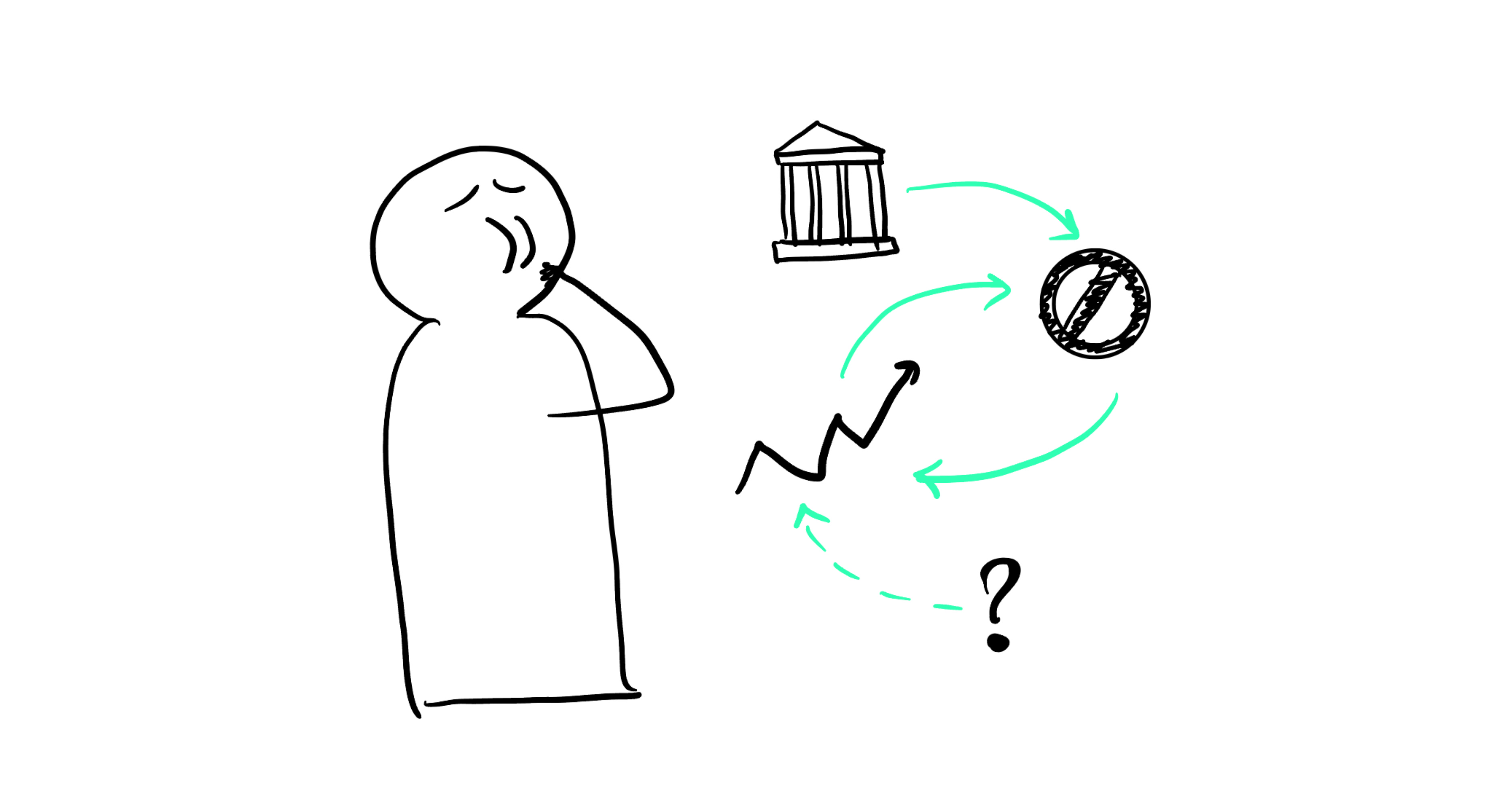
If the loops can be brought into agreement, -maybe by changing what the stock is taken to mean, by addressing the underlying conditions producing the resistance, by redefining the goal so that the population’s bounded rationality and the policy’s bounded rationality see the same target- the stock moves on its own, because nothing is holding it still. Everyone caught inside policy resistance is right, in the bounded-rationality sense, and the configuration’s stability is the consequence not of anyone being mistaken but of everyone being correct within their own view. The only move that resolves it is the redrawing of those views, changing what each loop reads as its goal, so that “sensible inside the loop” and “sensible for the system” stop pointing in opposite directions.
🧩 What’s Coming Next
This foundations series will build your systems thinking toolkit step by step:
15 | Resilience: You Won’t Notice Until It’s Gone ✔️
16 | Self-Organization: Assembly Not Required ✔️
17 | Hierarchy: Layers All the Way Down ✔️
18 | Policy Resistance Archetype: Everyone Was Right ✔️
19 | Shifting the Burden Archetype: Just Until Things Stabilize
📚 Main Resources
Meadows, D. H. (2015). Thinking in Systems. Chelsea Green Publishing.
Sterman, J.D. (2000) Business Dynamics: Systems Thinking and Modeling for a Complex World. Irwin McGraw-Hill, Boston.
Kligman, G. (1998). The Politics of Duplicity: Controlling Reproduction in Ceaușescu’s Romania. University of California Press.
Myrdal, A. & Myrdal, G. (1934). Kris i befolkningsfrågan [Crisis in the Population Question]. Bonniers, Stockholm.
My lecture notes from “System Dynamics” and “Simulation” classes :)
Some explanations and phrasings closely follow or directly quote these sources. The text was refined for coherence and citation accuracy with the assistance of large language models.