

System Dynamics | Foundation 17: Hierarchy
Layers All the Way Down

On where we are. Resilience, self-organization, and hierarchy are three structural properties that explain why complex systems work as well as they do, and why they’re so hard to see until they’re gone. This is the last one. The archetypes follow after.
There is a thing that happens to experienced drivers after a near-miss. For the next several minutes they find themselves thinking carefully about their hands on the wheel: where the thumb is hooked, how firmly they are gripping, whether the shoulders are square. And almost immediately they begin to drift inside their lane. The steering that was perfect a minute ago has gone slightly wrong. The harder they pay attention to it, the worse it gets.
The standard story for what makes someone a good driver is a story about accumulation. Practice, hours behind the wheel, muscle memory; the ten-thousand-hour version that says expertise is the eventual deposit of enough repetitions, that the difference between a novice and an expert is essentially how much each of them has done. By that account, paying more attention should make a driver better, not worse, because attention is what produced the expertise in the first place. The story does not explain what just happened on the road.
What is actually different
The expert and the novice are not the same kind of system; they are differently structured systems. On a second driving lesson, every action competes with every other action for the same conscious channel (foot pressure, mirror checks, the line of the lane, which exit comes next), and conscious attention can only do one thing at a time. The novice is overwhelmed not because the task is hard but because the structure is flat: there is no level beneath the conscious level for any of this work to live in. A few hundred hours later, lane-keeping has moved underneath the conversation the driver is having with their passenger; mirror checks have moved there too. By the time someone has fifteen years on the road, there is a stack: the moment-to-moment mechanics at the bottom, then the lane and traffic layer, then the route layer, and at the top the level conscious attention now occupies (hazard, judgment, exceptions). None of the lower layers reports to consciousness most of the time. They report only when something exceeds their own resolution. The expert is not paying attention to more things than the novice; the expert is paying attention to fewer.
What has formed is a hierarchy, in the specific sense Donella Meadows uses the word:
Hierarchy is a system organized as nested subsystems, with denser coupling within each level than between levels.
This is what was happening at the intersection. The near-miss frightened the driver into trying to operate the steering layer directly from the conscious layer, and the conscious layer is structurally incapable of doing that work at the speed and detail the steering layer requires.
The formal property
The asymmetry between within-level and between-level coupling shows up at every scale at which structure exists. Cells in your liver communicate constantly with each other and only occasionally with cells in your kidney. Members of an engineering team talk to each other every day and to the marketing team once a quarter. The steering subsystem in an expert driver runs continuously inside itself and reports upward only on exception. The signature of a hierarchy is not who is in charge.
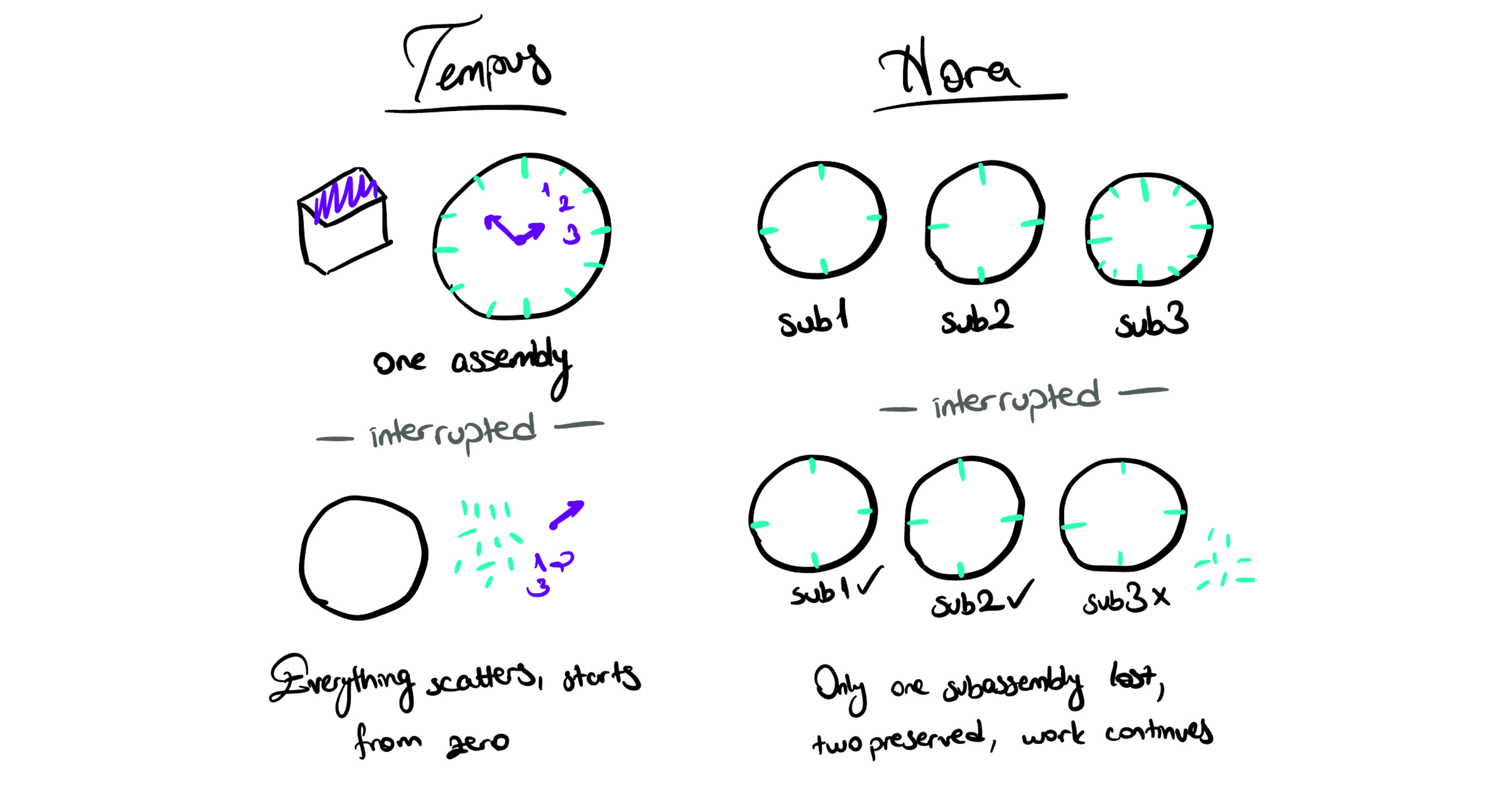
Herbert Simon, in a parable Meadows reproduces in “Thinking in Systems”, describes two watchmakers: one who builds his watches as single thousand-piece assemblies (Tempus), and one who builds them out of stable ten-piece subassemblies (Hora), ten of which combine into a larger subassembly, ten of which form the watch. Both are constantly interrupted by phone calls. The first loses everything each time the phone rings; the second loses only the subassembly currently in his hands. The second watchmaker survives. Simon’s point, which is the structural reason hierarchy is so common in nature and in evolved systems generally, is that complex systems can only emerge through stable intermediate forms. Anything more elaborate than that is disassembled by ordinary disturbance before it has time to become anything. Expertise, on this account, is not the accumulation of skill. It is the formation of the stable intermediate forms, the subassemblies, on which more complicated behavior can sit.
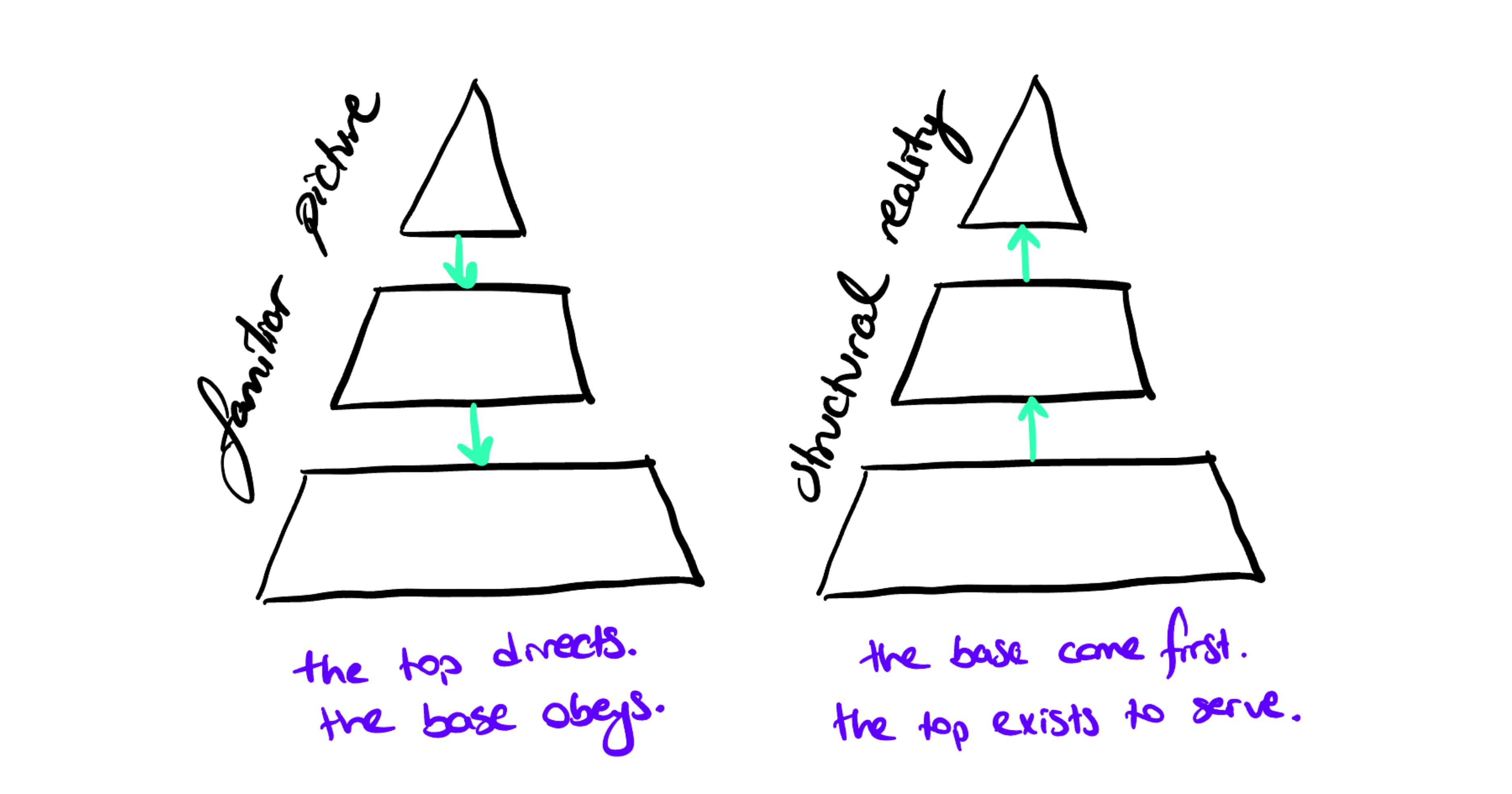
There is one further property of hierarchies that almost everyone gets backwards on first encounter, and Meadows is unusually direct about it. Hierarchies evolve from the bottom up. The upper layers exist to serve the lower layers, not to command them. Cells came first; tissues formed to support cells; organs formed to support tissues; the organism formed last and exists, structurally speaking, so that the cells can keep doing what they do. The same is true of the driving stack. The conscious layer is not the manager of the steering layer; it is the exception handler for what the steering layer cannot resolve on its own. When you understand a hierarchy correctly, the arrows of purpose run upward, not downward. This is the part that is hardest to see, because every cultural metaphor for hierarchy points the other way.
The picture most people carry when they hear the word hierarchy is the org chart. A pyramid with one box at the top and many at the bottom, lines of authority flowing downward, the title at the top deciding what the titles below it will do, the lowest layer existing to execute what the top layer commanded. In that picture, the upper layers are why the lower layers do anything, and the lower layers exist to serve the upper. The structural picture is the reverse. Cells did not assemble themselves into organs because some larger system instructed them to; the organism formed because the cells needed coordination they could not produce alone, and the organ layer formed to provide it. Consciousness did not invent the steering layer to do its bidding; it formed because the steering layer needed an exception handler it could not be. The upper layer exists because the lower layer required something it could not provide for itself. Read the org chart that way and most of what looks like authority is actually service.
Two failure modes
Once you can see the structure, two failure modes become visible, corresponding to the two directions in which a hierarchy can go wrong.
Overcontrol
The first is overcontrol. This is what happened at the intersection. The conscious layer, which exists to handle exceptions, attempts to operate one of the layers below it directly, and the function it tries to take over is the function that immediately degrades. Performance collapses the moment the upper layer starts running the lower layer’s work for it, because the lower layer was built to operate at a speed and granularity the upper layer cannot match. The most common version of this is anxiety. A public speaker who starts thinking about the position of their tongue begins stumbling over consonants they have been saying their entire life. A musician who starts thinking about her fingers in the middle of a familiar passage breaks the passage. The upper layer does not improve the lower layer’s performance by intervening; it destroys the conditions under which the lower layer was performing at all.
Meadows names this directly in the context of larger systems. A brain that controls its cells too tightly kills the organism. A central administration that regulates its faculty too tightly hollows the university. A coach who overrides the on-the-spot judgment of a good player loses the game. Central control past a certain threshold does not optimize the subsystem; it prevents the subsystem from doing the work it was built to do.
Suboptimization
The second failure mode is the opposite, and it is the one nobody warns you about. Suboptimization, in Meadows’ vocabulary, is what happens when a subsystem’s local goal dominates the goal of the whole. In the driving case, the version that matters is subtler than a corporation bribing the government. It is the failure mode of long habituation. The lower layers have run the route so many times that they have stopped flagging anything to the upper layer. The conscious layer’s model of the road is no longer being updated, because the lower layers have optimized themselves so thoroughly to a route they have learned that they no longer notice when the route has changed. This is the mechanism behind the accident on the commute someone has driven a thousand times. The driver did not stop paying attention. The lower layers stopped sending signals upward, and what looked like attention from the inside was, structurally, the absence of any input that required it.
Both failure modes emerge from the same property: the semi-autonomy of subsystems. Run the property in one direction and you get overcontrol: the upper layer reaches down and breaks the lower layer’s function. Run it in the other and you get suboptimization: the lower layer runs so cleanly that it isolates itself from the upper layer’s view. Functioning hierarchies live in the narrow corridor between these two, and a great deal of what looks like skill is the constant maintenance of that corridor.
Sleep is the limit case. The hierarchy runs at full intensity with the upper level entirely offline, which means consciousness is not the apex of the system. It is the most interruptive part of it.
What changes when you can see it
Expertise is hierarchy formation. It is not the accumulation of knowledge, and it is not the accumulation of repetitions; it is the structural transition from a flat system, in which every action competes for the same channel, to a layered system, in which most of the work has moved underneath consciousness and consciousness has been freed for the work that only it can do. This is why expertise cannot be transferred by transferring information: the hierarchy has to form. It is why anxiety degrades expert performance, the upper layer reaches down into the lower layer and breaks it. It is why the most experienced practitioners can fail in ways novices cannot. The lower layers, optimized too well, stop reporting anything upward, and the upper-layer model of the world goes stale without anyone noticing.
The same logic generalizes outward without much modification. Any system you are trying to improve by adding central control is at risk of overcontrol; any system that has been running smoothly without your attention for a long time is at risk of suboptimization; both break the corridor between layers.
What changes, when you can see hierarchy correctly, is what you stop trying to do. You stop trying to operate the lower layers from the upper ones. You stop trying to flatten the system in the name of visibility. You stop trying to remove the semi-autonomy that the structure depended on for its function. The arrow of purpose, in any working hierarchy, runs upward. Any system in which that arrow has reversed has stopped being a hierarchy in the structural sense and become something else, usually something worse.
🧩 What’s Coming Next
This foundations series will build your systems thinking toolkit step by step:
14 | Exponential Growth & Collapse: Fine, Fine, Fine, Oh No ✔️
17 | Hierarchy: Layers All the Way Down ✔️
18 | Policy Resistance Archetype: Everyone Was Right
19 | Shifting the Burden Archetype: Just Until Things Stabilize
📚 Main Resources
Meadows, D. H. (2015). Thinking in Systems. Chelsea Green Publishing.
Sterman, J.D. (2000) Business Dynamics: Systems Thinking and Modeling for a Complex World. Irwin McGraw-Hill, Boston.
My lecture notes from “System Dynamics” and “Simulation” classes :)
Some explanations and phrasings closely follow or directly quote these sources. The text was refined for coherence and citation accuracy with the assistance of large language models.